Why Too Many Options Can Make Businesses Choose Poorly
real estate
Why Too Many Options Can Make Businesses Choose Poorly
Searching for commercial property?
Learn how choice overload, decision fatigue and irrelevant listings can slow leasing decisions—and how businesses can build a smarter property shortlist.
5 October 2026Admin8 min read
Too Many Properties, Too Little Clarity: Why Commercial Property Search Can Become a Decision Problem
Searching for commercial property sounds simple.
Open a property portal.
Enter a location.
Set a budget.
Choose the required area.
Start comparing.
But then something interesting happens.
Instead of finding the right property, the business finds 50 properties that might work.
Then 100.
Then 200.
And suddenly the problem isn't:
“Can we find a property?”
It becomes:
How do we know which property actually deserves our attention?
That distinction matters.
Because commercial leasing is rarely a simple yes-or-no decision.
A business may need to evaluate location, accessibility, area, frontage, parking, operations, economics, infrastructure, customer reach and future requirements at the same time.
The result can be a surprising problem:
More options can create less clarity.
1. The Property Search Paradox
Businesses usually believe:
More listings = better chances of finding the right property.
That sounds logical.
But psychology tells us that more choice is not always better.
Research by Sheena Iyengar and Mark Lepper found that people can become less likely to choose when faced with a very large assortment compared with a smaller, more manageable set.
Later research found that choice overload becomes particularly relevant when decisions are complex, preferences are uncertain and alternatives differ across many attributes.
PubMed +1
Commercial property is almost the perfect environment for this problem.
Why?
Because a property isn't judged on one attribute.
It is judged on many.
Rent + location + area + access + parking + visibility + infrastructure + business fit + future potential.
So the search becomes increasingly complicated as the number of alternatives grows.
2. A Business Doesn't Actually Want 100 Properties
It wants something much more valuable:
A small number of relevant properties.
Imagine a business requirement:
3,000–4,000 sq. ft.
Ground floor
Main-road visibility
Specific micro-market
Parking required
Strong customer accessibility
Commercial power
Budget within a defined range
Now imagine receiving:
150 listings.
Some are too expensive.
Some are on the wrong road.
Some don't have parking.
Some have the wrong configuration.
Some look attractive but don't support the business model.
Some have incomplete information.
The business now has to do the filtering itself.
The search has become a data-cleaning exercise instead of a property decision.
3. This Is Where Decision Fatigue Begins
Every property creates questions.
Property A
Good location—but expensive.
Property B
Affordable—but poor visibility.
Property C
Excellent building—but difficult access.
Property D
Perfect area—but too little parking.
Property E
Great space—but doesn't support expansion.
After reviewing enough options, the decision-maker starts experiencing something familiar:
Let's shortlist these for now and come back later.
Then another property appears.
Then another.
And the shortlist grows from 5 to 12.
Then 12 becomes 20.
Eventually, the business isn't comparing properties anymore.
It is comparing spreadsheets.
4. The Psychology Behind the Problem
Three psychological effects become particularly important.
A. Choice Overload
When the number and complexity of alternatives increase, evaluating them can become harder.
The issue isn't simply the number of properties.
It is the number of differences the decision-maker has to process.
ScienceDirect +1
B. Decision Fatigue
Commercial property decisions rarely happen in isolation.
The same person may already be deciding:
hiring
budgets
vendors
expansion
operations
marketing
finance
Then comes:
Which property should we lease?
The mental cost accumulates.
A complicated property search can therefore consume valuable managerial attention.
C. Loss Aversion
There is another powerful psychological force:
Nobody wants to choose the wrong property.
The fear isn't only:
What if we miss the best property?
It is also:
What if we choose this one and regret it later?
That fear can delay decisions.
And sometimes the business ends up choosing the most familiar or easiest-to-justify option—not necessarily the best one.
5. Why Similar Properties Create an Even Bigger Problem
Suppose a business has three properties:
Property
Rent
Area
Location
Access
Parking
A
₹2.0L
3,500 sq.ft.
Good
Good
Limited
B
₹2.2L
3,300 sq.ft.
Excellent
Excellent
Good
C
₹1.8L
3,800 sq.ft.
Average
Good
Good
Which one is best?
There is no universal answer.
It depends on the business.
A showroom may prioritize visibility.
An office may prioritize employee accessibility.
A warehouse may prioritize logistics.
An F&B business may prioritize customer access and catchment.
This is why:
The “best property” does not exist in isolation.
There is only:
The best-fit property for a particular business requirement.
6. The Cost of Irrelevant Listings
An irrelevant listing may appear harmless.
But every irrelevant option creates a small amount of work.
Open.
Read.
Compare.
Check location.
Check area.
Check price.
Ask for details.
Reject.
Repeat.
Multiply this by dozens of listings.
The business has now spent hours evaluating properties that were never serious candidates.
That is a hidden search cost.
And in commercial leasing, management time has a value.
7. The Better Approach: Build a Consideration Set
Instead of asking:
How many properties can we find
ask:
How many properties genuinely deserve evaluation?
A practical approach is to divide requirements into three levels.
MUST HAVE
Requirements that eliminate a property if they are missing.
Examples:
Specific location
Minimum area
Budget ceiling
Ground floor
Required access
PREFERRED
Important, but negotiable.
Examples:
Better frontage
Additional parking
Newer building
Higher visibility
FLEXIBLE
Features that can be compromised if the overall opportunity is strong.
Examples:
Exact floor
Minor area variation
Interior condition
Certain amenities
This creates a much cleaner decision structure.
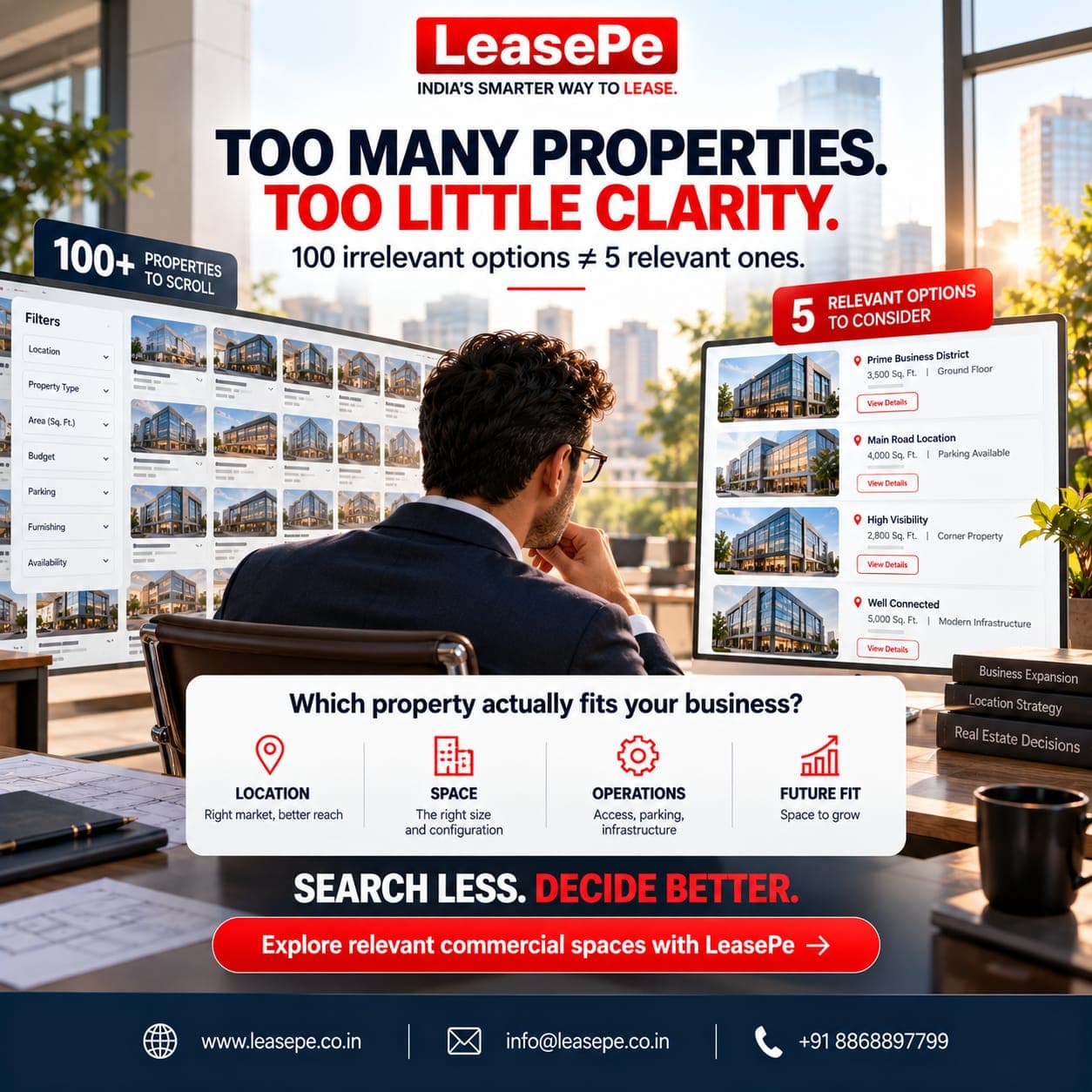
8. From 100 Listings to 10 Relevant Options
A smarter commercial search can follow a funnel:
100+ MARKET OPTIONS
↓
30 POTENTIALLY SUITABLE
↓
10 RELEVANT OPTIONS
↓
3–5 SERIOUS SHORTLISTS
↓
2–3 SITE VISITS
↓
1 BUSINESS DECISION
The numbers are illustrative, not a universal rule.
The principle is what matters:
Discovery should create options.
Evaluation should create clarity.
9. What Should a Business Compare?
Once a shortlist is created, don't compare properties randomly.
Use a consistent scorecard.
LOCATION
Does the micro-market support the business?
ACCESS
Can customers, employees or logistics reach it efficiently?
SPACE
Does the usable configuration support operations?
ECONOMICS
Does the total cost make commercial sense?
OPERATIONS
Can the business function efficiently from the property?
EXPERIENCE
Does the property support customers and employees?
FUTURE FIT
Can the business grow without immediately outgrowing the space?
CBRE's current site-selection approach similarly emphasizes looking beyond a simple map by incorporating labour, logistics, infrastructure, competition and cost into location decisions.
CBRE India
10. Why “Search” and “Selection” Are Different Problems
This distinction is often overlooked.
SEARCH asks:
What properties exist?
SELECTION asks:
Which properties make sense for us?
The first is about discovery.
The second is about decision-making.
And the second is where businesses need much more clarity.
Colliers' tenant-representation approach explicitly focuses on understanding the business strategy, competitors and industry drivers before evaluating space, location, functionality, flexibility and cost.
Colliers +1
That is a fundamentally different mindset from simply browsing available properties.
11. The Human Side of Commercial Leasing
Behind every commercial property decision is a human decision-maker.
They may be thinking:
Will this work?
Will my team accept it?
Will customers come here?
What if we choose wrong?
Are we paying too much?
What happens if the business grows?
A good property search therefore shouldn't only provide more information.
It should reduce uncertainty.
That is a very different product philosophy.
12. What a Better Leasing Experience Looks Like
Imagine two experiences.
EXPERIENCE A
Here are 200 commercial properties.
The business has to do the filtering.
EXPERIENCE B
Based on your requirement, here are the properties that appear most relevant—and here is why.
The second experience creates something extremely valuable:
Confidence.
Not because the decision has been made for the business.
But because the business can understand why these options deserve attention.
13. This Is Where Technology Can Help
Technology is increasingly changing how leasing decisions are evaluated.
CBRE notes that AI and predictive analytics are being used to move leasing from historical, intuition-driven decisions toward more data-informed forecasting and scenario analysis.
CBRE India
But technology should not mean:
Show the user more properties faster.
The better question is:
How can technology help the user reach a better decision with less unnecessary effort?
That is a product-design question as much as a real-estate question.
14. The LeasePe Opportunity
LeasePe's role should not simply be:
More properties.
It should be:
More relevant possibilities.
A business requirement contains signals:
Location
Property type
Area
Budget
Access
Parking
Visibility
Operational needs
Growth plans
When these signals are understood properly, property discovery becomes more useful.
Instead of asking the business to evaluate everything available, the objective becomes:
Help the business focus on what deserves attention.
That is consistent with LeasePe's broader positioning around connecting commercial properties with
business requirements rather than treating leasing as a simple availability listing exercise.
LeasePe
15. The New Definition of a Good Property Search
A good property search isn't necessarily the one that produces the largest number of results.
It is the one that helps a business move from:
SEARCH
→ UNDERSTAND
→ SHORTLIST
→ VISIT
→ DECIDE
with less unnecessary friction.
Because businesses don't lease properties to collect options.
They lease properties to run, serve, operate and grow their businesses.
Final Thought
The commercial real-estate industry has traditionally celebrated inventory.
More listings.
More properties.
More choices.
But the future of leasing may be less about how many properties a business can see and more about how quickly it can identify the properties worth seeing.
Because:
100 irrelevant options are not better than 5 relevant ones.
And the smartest commercial property search isn't the one that gives a business more to choose from.
It's the one that gives them more clarity about what to choose.
LeasePe
Where Business Requirements Meet Commercial Spaces.
Whether you are a business searching for the right commercial space or a property owner looking for relevant business requirements, LeasePe focuses on making the leasing journey more structured, relevant and easier to navigate.
LeasePe isn't valuable because it gives businesses more properties.
It's valuable when it helps businesses find more relevant properties.
Discover how choice overload, decision fatigue and irrelevant listings can slow leasing decisions—and how businesses can build a smarter property shortlist.
commercial property search
commercial property search India, commercial property selection, commercial space search, commercial property for lease, commercial space for rent, commercial leasing decisions, property search for business, commercial property shortlist, commercial real estate India, business property search
/blog/commercial-property-search-choice-overloadcommercial property search India, commercial property selection, commercial space search, commercial property for lease, commercial space for rent, commercial leasing decisions, property search for business, commercial property shortlist, commercial real estate India, business property search
Discover how commercial property influences customer trust, employee experience, brand perception and business performance—and what businesses should evaluate beyond rent and area.