Office Location Strategy: Why Your Commercial Location Is a Talent Decision | LeasePe
real estate
Office Location Strategy: Why Your Commercial Location Is a Talent Decision | LeasePe
Your office location affects more than rent. Learn how commute, talent access, workplace experience and location psychology influence commercial leasing decisions in India.
8 October 2026Admin8 min read
Your Office Location Is a Talent Decision: Why Businesses Should Think Beyond Rent & Address
When businesses compare office spaces, the conversation often starts with:
Rent.
Then:
Area.
Then:
Building quality.
Then:
Location.
But there is another question hiding underneath all of them:
Who will actually want to work here?
Because an office isn't occupied by spreadsheets.
People occupy it.
Employees commute to it.
Candidates evaluate it.
Managers build teams around it.
Clients experience it.
Businesses grow from it.
That makes office location more than a real-estate decision.
It becomes a people decision.
And this is becoming increasingly important in India's commercial office market.
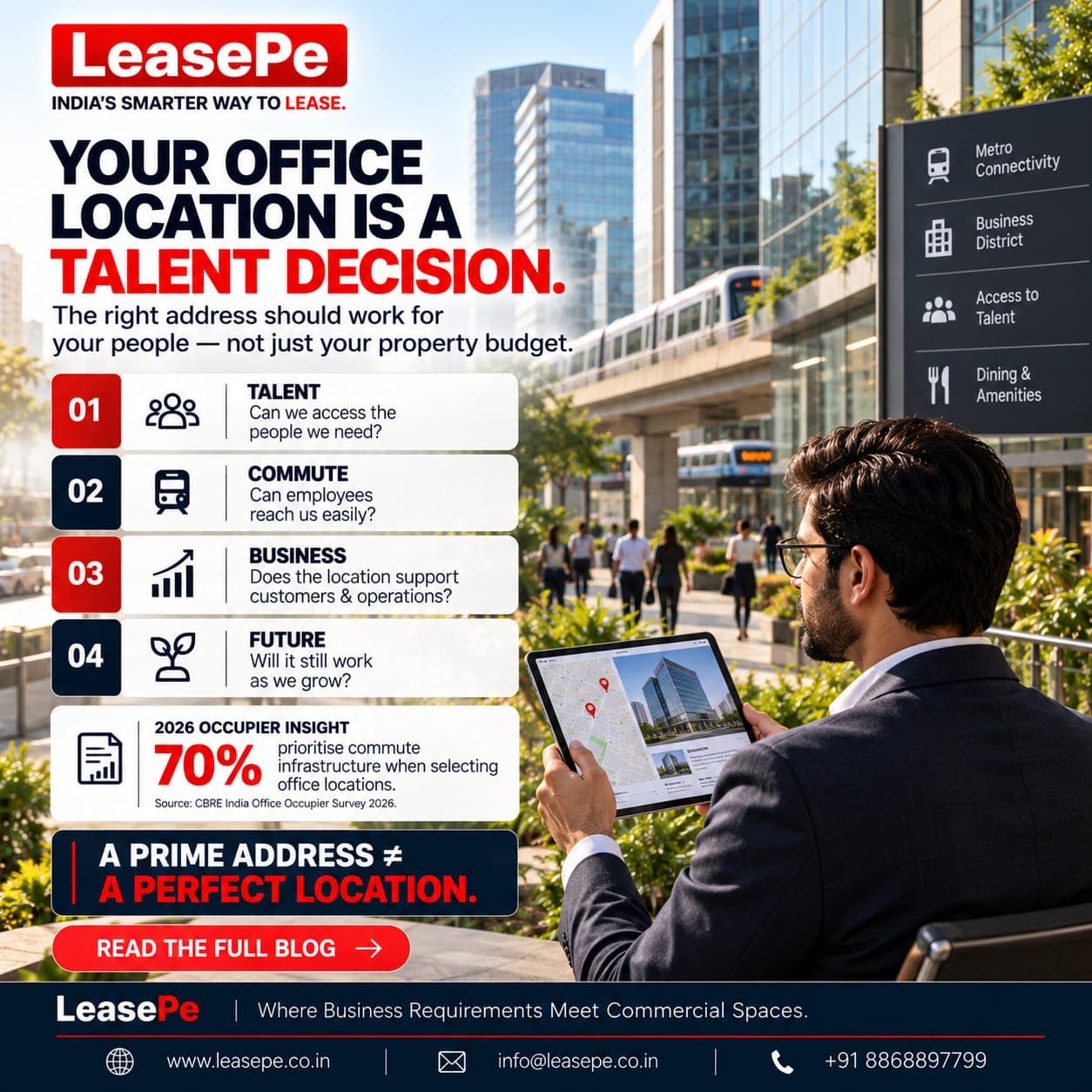
CBRE's 2026 India Office Occupier Survey found that 70% of occupiers prioritise commute infrastructure when selecting office locations. The survey also identifies talent accessibility, workplace experience and sustainability among the factors increasingly shaping leasing decisions.
CBRE
So perhaps the better question isn't:
Is this a good office?
It is:
Is this a good place for our people and our business?
1. A PRIME ADDRESS CAN STILL BE A POOR PEOPLE DECISION
A prestigious address can look impressive on a presentation.
But imagine an employee who needs:
two hours to reach work,
multiple transport changes,
expensive daily commuting,
limited public transport,
difficult last-mile connectivity.
The address may look excellent on a map.
The employee may experience it very differently.
This is the difference between:
Location visibility
and
Location usability.
JLL's research on Indian office leasing has similarly emphasized that location decisions are more nuanced than simply choosing a central or prestigious address; workforce needs, industry ecosystems and operational efficiency all influence the decision.
JLL
A location isn't valuable simply because people recognize its name.
It is valuable when it works for the people and business that need to use it.
2. COMMUTE IS PART OF THE WORKPLACE EXPERIENCE
Consider two offices.
Office A
₹100/sq. ft.
Excellent building.
Prestigious address.
Poor connectivity.
Office B
₹105/sq. ft.
Slightly higher rent.
Better metro access.
Better public transport.
Easier employee commute.
Which is cheaper?
The answer cannot be found by looking only at rent.
The business also needs to think about:
employee accessibility
recruitment
retention
attendance
time lost commuting
employee experience
talent pool
A slightly cheaper property can create hidden operational friction if it makes hiring and commuting harder.
This is why location strategy increasingly needs to connect real estate economics with human economics.
3. THE TALENT POOL HAS A GEOGRAPHY
A business doesn't hire from an abstract city.
It hires from a population.
And that population has a geography.
Imagine a company needs:
software engineers
finance professionals
sales teams
customer-support employees
senior managers
Each talent group may have different location preferences and commuting patterns.
So the question becomes:
Where can this business realistically access the people it needs?
JLL's location-strategy approach explicitly incorporates labour analytics, market dynamics and site metrics to help businesses identify locations where operations can perform effectively.
JLL
This is an important shift.
The office is no longer simply where the company sits.
It is part of where the company can build its workforce.
4. WHY PEOPLE REJECT “GOOD” OFFICES
This is where client psychology enters the picture.
A property may satisfy the company's financial criteria.
But employees don't evaluate it through a financial model.
They think:
How will I get there?
How long will it take?
What is around the office?
Will I feel comfortable working here?
Can I get home easily?
Will good candidates accept this location?
These questions create a second evaluation layer.
Business Fit
and
Human Fit.
The strongest office location needs both.
5. LOCATION HAS A DAILY COST THAT DOESN'T APPEAR ON THE LEASE
Imagine an employee spends an additional 45 minutes commuting each way because of the office location.
That is:
90 minutes per day.
Across a working month, the accumulated time becomes significant.
Now multiply that across hundreds of employees.
The point isn't that every minute can be converted neatly into money.
The point is that location creates a recurring human experience.
And recurring experiences influence how people feel about work.
This is why CBRE's latest India occupier research identifies commute infrastructure as a major location criterion, alongside talent accessibility and workplace experience.
CBRE
6. THE OFFICE ALSO COMPETES FOR TALENT
Businesses compete for customers.
But they also compete for people.
A company may offer:
strong salary,
good culture,
career growth,
hybrid flexibility,
yet still make recruitment harder if the office is difficult to access.
The physical workplace therefore becomes part of the employee value proposition.
This doesn't mean every business needs a premium CBD address.
It means the location should make sense for the workforce the company is trying to attract.
The best location isn't always the most prestigious.
It is often the one that makes the business easiest to reach for the right people.
7. LOCATION PSYCHOLOGY: PEOPLE DON'T EXPERIENCE DISTANCE AS A NUMBER
A map might say:
12 km.
But people experience:
45 minutes.
Or:
two metro changes.
Or:
an unreliable last-mile connection.
Or:
a comfortable direct commute.
This is an important psychological distinction.
Businesses often evaluate property through measurable attributes:
₹/sq. ft.
Area
Distance
Parking spaces
People experience those same decisions differently:
Time
Effort
Convenience
Stress
Accessibility
So a human-centred leasing decision needs both forms of thinking.
8. THE “RIGHT LOCATION” DEPENDS ON THE BUSINESS
There is no universally perfect office location.
A startup with 30 employees may value flexibility and accessibility.
A technology company with 1,000 employees may prioritise talent concentration and transport infrastructure.
A financial-services company may value a particular business ecosystem.
A manufacturing business may care more about workforce availability, logistics and operational access.
A healthcare company may need proximity to patients and specialist talent.
Therefore:
Location should start with the business model—not the property brochure.
Cushman & Wakefield's tenant-representation approach similarly frames site selection around business goals, workplace strategy, location, logistics and evolving occupier requirements rather than treating the property as an isolated product.
Cushman & Wakefield +1
9. A BETTER OFFICE LOCATION SCORECARD
Instead of asking only:
Is this a good location?
Businesses can evaluate it across five dimensions:
Dimension
Question
Talent
Can we access the people we need?
Commute
Can employees reach it conveniently?
Business
Does the location support customers and operations?
Experience
Does the environment support the workplace we want?
Future
Will the location still work as we grow?
This produces a more realistic definition of location fit.
10. THE NEW OFFICE LOCATION EQUATION
Think of commercial location as:
LOCATION VALUE ≠ ADDRESS VALUE
Instead:
LOCATION VALUE = BUSINESS FIT + PEOPLE FIT + FUTURE FIT
A famous address can have high visibility.
But if it creates poor employee accessibility, recruitment friction or operational difficulty, its practical value may be lower than expected.
Likewise, a less prestigious location can become highly valuable if it provides:
better talent access
better connectivity
better economics
better employee experience
better scalability
That is why businesses should resist choosing a location simply because it looks impressive on a map.
11. WHAT THIS MEANS FOR PROPERTY OWNERS
This shift matters for landlords too.
If you are marketing an office property, don't communicate only:
Prime Location.
Explain the human value of the location.
For example:
Metro connectivity
Public transport access
Major residential catchments
Nearby amenities
Parking
Food and daily services
Employee convenience
Business ecosystem
Accessibility for clients
A property's location story should answer:
Why would people want to come here?
Not simply:
Where is it?
12. WHAT THIS MEANS FOR BUSINESSES
Before choosing an office, ask five questions:
01 — WHO ARE WE TRYING TO ATTRACT?
Define the talent you actually need.
02 — HOW WILL THEY REACH US?
Study real commute patterns, not just map distance.
03 — WHAT DOES THE LOCATION MAKE EASIER?
Customers? Employees? Vendors? Partners?
04 — WHAT DOES IT MAKE HARDER?
Traffic? Recruitment? Cost? Accessibility?
05 — WILL THIS STILL WORK IN THREE YEARS?
A location should support the business you are building—not only the business you have today.
THE BIGGER IDEA
Commercial real estate is often described in square feet.
But businesses experience space through people, time and behaviour.
An office can influence:
who applies,
who accepts the job,
who stays,
how people commute,
how teams interact,
and how the business grows.
That makes location far more than a line on a property listing.
It becomes part of the company's operating system.
THE LEASEPE PERSPECTIVE
At LeasePe, we believe commercial leasing should begin with understanding what the business is actually trying to achieve.
Because the right commercial space isn't simply:
Available.
It isn't simply:
Affordable.
And it isn't simply:
In a prime location.
It should be relevant to the business.
For an office, that means thinking beyond rent and square footage.
It means considering:
Business requirements.
People requirements.
Operational requirements.
Future requirements.
That is where better property-business matching becomes more meaningful.
FINAL THOUGHT
The next time someone says:
This is a great office because it's in a prime location.
Ask one more question:
Prime for whom?
Because a location is only truly valuable when it works for the people, business and future that depend on it.
The best office isn't always the one with the best address.
It's the one that helps the business and its people perform better.
LeasePe
India's Smarter Way to Lease.
Where Business Requirements Meet Commercial Spaces.
A “prime location” means very little if your best people don't want to commute there.
office location strategy
office location strategy India, commercial office leasing, office space for lease, employee commute office, talent accessibility, commercial property leasing, workplace strategy
office location strategy Secondary Keywords office location strategy India commercial office leasing office space for lease commercial property leasing office location selection commercial real estate India employee commute office talent accessibility workplace strategy office space for business Your Office Location Is a Talent Decision
/blog/office-location-talent-decisionoffice location strategyoffice location strategy Secondary Keywords office location strategy India commercial office leasing office space for lease commercial property leasing office location selection commercial real estate India employee commute office talent accessibility workplace strategy office space for business Your Office Location Is a Talent Decisionoffice location strategy office location strategy India, commercial office leasing, office space for lease, employee commute office, talent accessibility, commercial property leasing, workplace strategy
Why do businesses reject seemingly good commercial properties? Explore 7 decision-friction points that influence commercial property leasing decisions in India.