Commercial Property Climate Resilience: What Businesses Should Know | LeasePe
Discover how heat, flooding, power reliability and building resilience can affect commercial property leasing in India. Learn what businesses should evaluate before choosing a space.
13 October 2026Admin14 min read
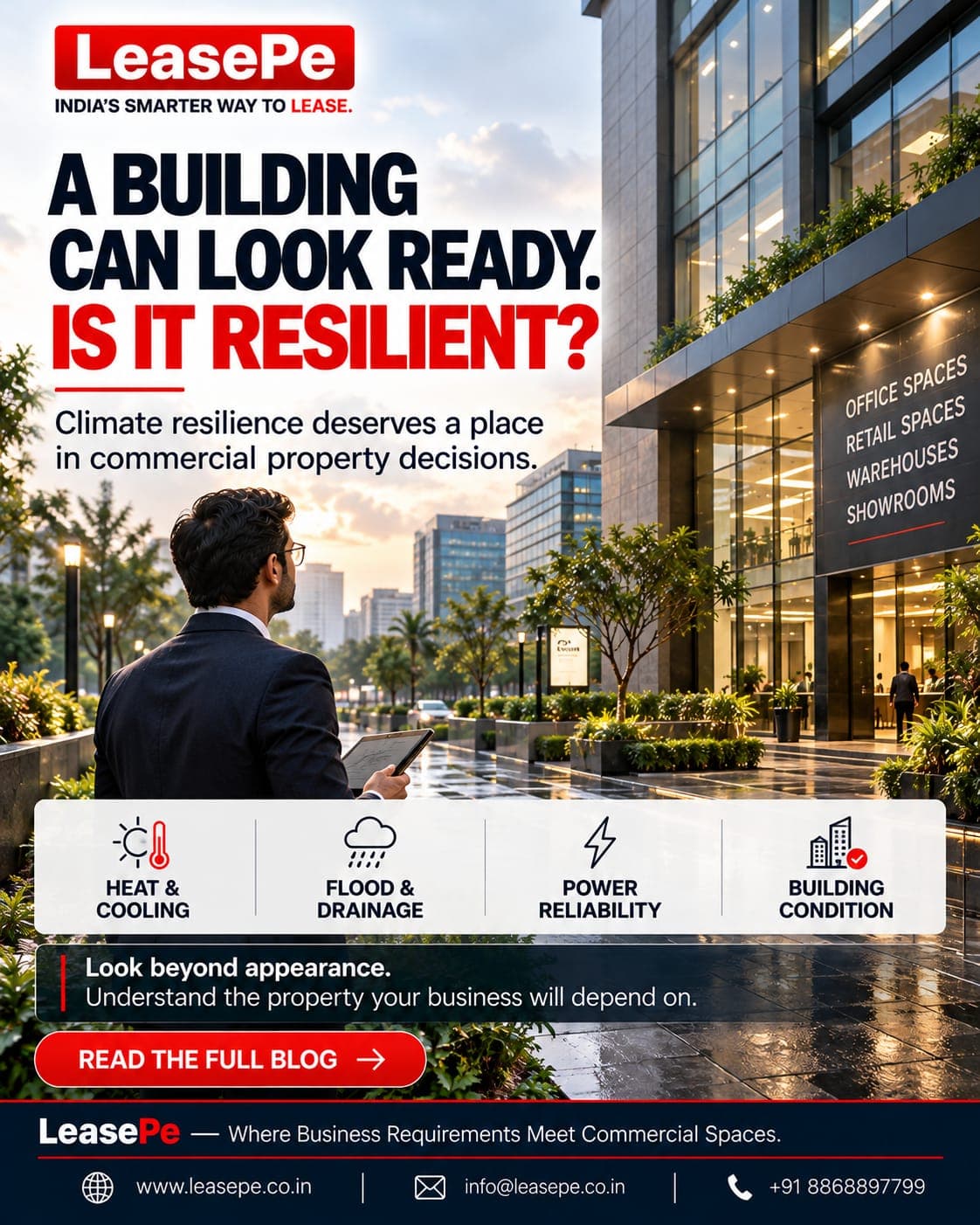
A BUILDING CAN LOOK READY. IS IT RESILIENT?
Why climate resilience deserves a place in commercial property decisions.
Beyond Green Buildings: Is Your Commercial Property Ready for the Future?
The hidden connection between climate resilience, business continuity and smarter commercial leasing in India
Beyond Green Buildings: Is Your Commercial Property Ready for the Future?
Imagine finding a commercial property that looks perfect.
The building is modern.
The location is excellent.
The rent fits your budget.
The interiors look impressive.
Everything seems right.
But what happens when the temperature rises sharply during summer? What happens if heavy rainfall disrupts access to the building? What happens if the power supply becomes unreliable during a critical business day?
These questions might not come up during the first property visit.
Yet they can influence how effectively a business operates after signing the lease.
A commercial property must do more than look good today. It should be capable of supporting the business through changing conditions tomorrow.
This is where climate resilience becomes an important part of commercial real estate.
It is not simply about planting trees, installing solar panels or obtaining a green-building certification. It is also about understanding how a property responds to environmental stress, maintains essential services and supports business continuity.
For businesses leasing commercial space in India, this deserves greater attention.
1. A Beautiful Building Is Not Necessarily a Resilient Building
When people evaluate commercial property, they naturally notice what they can see.
The façade.
The lobby.
The interiors.
The parking.
The surrounding neighbourhood.
These features help create a first impression, but they don't reveal everything about a building's ability to perform under challenging conditions.
Consider two commercial buildings.
Building A
Modern glass façade
Premium interiors
Attractive entrance
Limited information about energy performance or weather-related risks
Building B
Practical building design
Well-maintained essential systems
Documented drainage and water-management arrangements
Appropriate backup arrangements
Clear information about energy performance and relevant building certifications
Which building is better?
The answer depends on the property's actual specifications, location, maintenance, intended use and the business's requirements.
The important point is that appearance alone cannot establish resilience.
A building can be visually impressive and still have vulnerabilities that require investigation.
For a business, the real question is not simply how a property looks. It is how reliably the property can support operations.
2. Extreme Heat Can Become an Operational Problem
India's commercial buildings operate across varied climatic conditions.
In some markets, intense summer heat places greater pressure on cooling systems. In others, humidity and seasonal rainfall introduce different operational challenges.
These conditions matter because commercial spaces depend on systems that help people work comfortably and equipment function reliably.
Consider an office with inadequate cooling capacity.
Employees may experience discomfort. Equipment rooms may require additional cooling. Energy consumption may increase if systems operate inefficiently. Businesses may need to investigate whether the existing infrastructure can support their actual requirements.
For certain businesses, temperature management is even more critical.
A data-sensitive operation, specialised manufacturing facility, healthcare-related business or temperature-controlled storage operation may have requirements that differ substantially from those of a conventional office.
This is why businesses should evaluate a property's cooling and ventilation arrangements in the context of its intended use.
What should businesses investigate?
Is the cooling system appropriate for the intended occupancy and equipment?
What is known about the building's energy performance?
Are ventilation and maintenance arrangements documented?
Can the existing electrical infrastructure support the required systems?
Are there known overheating issues or operational constraints?
The objective is not to assume that every building will experience problems.
It is to identify whether the property is equipped to support the business using it.
Comfort is part of workplace quality. Reliable infrastructure is part of business continuity.
3. Heavy Rainfall Can Test More Than a Building's Roof
A commercial property can remain structurally unaffected by a weather event and still experience operational disruption.
Think about the complete journey to work.
Employees need to reach the office. Customers may need access to a showroom. Suppliers may need to deliver goods. Logistics teams may need uninterrupted movement.
Now imagine that heavy rainfall causes waterlogging on the surrounding road.
The building may be open, but access becomes difficult.
A retail business may experience fewer customer visits.
Employees may face delays. Deliveries may become complicated.
This illustrates an important distinction:
A property's resilience is not determined by the building alone. Its surroundings matter too.
Businesses evaluating commercial property should consider the wider site and local environment.
Relevant questions include:
Does the property have a documented history of waterlogging or flooding?
How is surface water managed?
Is the site located in an area identified as vulnerable to flooding?
Are access roads likely to be affected during heavy rainfall?
What drainage and water-management arrangements are in place?
Are emergency access routes available?
The appropriate level of investigation will depend on the property's location, size, use and exposure to risk.
For a small office, the assessment may be relatively straightforward.
A warehouse, industrial facility or critical operations centre may require a more detailed review.
The lesson is simple.
Don't evaluate only the property you enter. Evaluate the environment your business will depend on.
4. Power Reliability Is Part of Property Resilience
For many businesses, electricity is not merely a utility expense.
It is essential to daily operations.
An office may depend on electricity for lighting, computers, networking, cooling and access-control systems.
A warehouse may require powered equipment, inventory systems and security infrastructure.
A manufacturing facility may depend on electrical supply for production machinery.
The consequences of an interruption vary considerably between these businesses.
A short disruption might be manageable for one company and operationally significant for another.
That is why businesses should understand the electrical infrastructure available at a property before committing to it.
Questions worth asking
Electrical capacity: Can the property support the business's expected load?
Backup arrangements: What backup systems exist, and what can they support?
Maintenance: Who maintains the relevant equipment?
Operating limitations: Are there restrictions or additional costs associated with backup power?
Business requirements: What level of continuity does the operation actually need?
Backup systems should not automatically be treated as proof of resilience. Their capacity, condition, maintenance and suitability need to be assessed.
A business with critical operations may also need a specialist to evaluate its continuity requirements.
The goal is to understand whether the building's infrastructure matches the operational consequences of a power interruption.
A property should not simply accommodate the business on an ordinary day.
Its infrastructure should be appropriate for the conditions under which the business must operate.
5. Green Buildings and Resilient Buildings Are Related—but Different
The terms green building and climate-resilient building are often discussed together.
They are related, but they describe different aspects of building performance.
Green-building performance
This commonly concerns areas such as:
Energy efficiency
Water efficiency
Resource consumption
Waste management
Indoor environmental quality
Environmental impact
Climate resilience
This focuses more directly on how a building and its essential systems can anticipate, withstand, respond to and recover from relevant environmental hazards.
Depending on the property and its location, this might involve:
Heat-risk management
Flood exposure and drainage
Reliable essential services
Appropriate building materials and design
Emergency planning
Maintenance and recovery procedures
A building can perform well in some sustainability categories while still having a particular vulnerability that matters to an individual occupier.
Likewise, a property does not need to have every possible green feature to be appropriate for a business.
The right assessment depends on the building, the local risks and the way the space will be used.
This distinction matters because commercial leasing decisions should be based on relevant evidence rather than attractive labels alone.
Colliers' 2026 India office outlook identifies sustainability-focused and climate-resilient workplaces as part of the market's evolving direction. That makes building performance an increasingly relevant subject for occupiers evaluating long-term commercial space.
Colliers +1
6. Why Climate Resilience Matters to the Business, Not Just the Building
Imagine two businesses operating from commercial properties in the same city.
One business depends on walk-in customers and daily deliveries.
The other operates primarily through remote services and requires relatively little physical movement.
The same weather-related disruption may affect them differently.
For the first business, inaccessible roads could affect customers, deliveries and daily sales.
For the second, the more significant issue might be power reliability, cooling or the continuity of its digital infrastructure.
This is why climate-related property risks should not be evaluated in isolation.
They need to be connected to the business model.
A useful way to think about the relationship is:
Property condition → Operational reliability → Business continuity
The relationship is not identical for every business. The relevant risks, consequences and mitigation measures vary.
But the underlying principle is consistent: a physical space can influence how well an organisation performs when conditions change.
A practical example
A business is choosing between two warehouse properties.
Both offer similar rental rates and storage capacity.
However, one property has better-documented drainage arrangements, suitable loading access and clearer information about backup infrastructure.
The other has an attractive location but limited information about these factors.
The second property is not automatically unsuitable.
But the lack of information creates questions that the business should resolve before making its decision.
The comparison should consider the cost of occupancy alongside the operational consequences of the risks identified.
A property decision becomes more meaningful when the business understands not only what it is paying for, but also what it is depending on.
7. The Psychology of Ignoring Risks We Cannot See
There is a human reason why these questions are sometimes overlooked.
When people evaluate a property, visible features are easy to notice.
A premium lobby creates an immediate impression. A good location feels valuable. Attractive interiors help people imagine how the business might look in the space.
By contrast, the quality of drainage infrastructure or the reliability of essential systems may require documentation, inspection or technical expertise.
This creates an information imbalance.
The attractive features are immediately available to the mind.
The less-visible risks require deliberate investigation.
People can therefore give more attention to what a property offers today than to what might affect its performance under different conditions.
is not necessarily carelessness. It is a practical limitation of making decisions with incomplete information.
But commercial leasing often involves commitments that extend over several years.
That makes it important to move beyond the first impression.
A more useful question
Instead of asking only:
“What do we like about this property?”
Ask:
What would we need to understand before depending on this property?
That question changes the evaluation process.
It encourages businesses to look for evidence, identify uncertainties and investigate issues relevant to their operations.
The objective is not to become suspicious of every building.
It is to make a more informed decision.
8. A Practical Climate-Resilience Assessment for Commercial Property
Before leasing a commercial property, businesses can use the following framework to identify questions that deserve attention.
Assessment area
What to investigate
Why it matters
Heat and cooling
Cooling capacity, ventilation and energy performance
Workplace comfort and operational requirements
Flood exposure
Local flood history, drainage and site conditions
Access and potential water-related disruption
Power
Electrical capacity, backup systems and maintenance
Continuity of essential operations
Water
Supply reliability, storage and relevant water-management systems
Day-to-day operational needs
Building condition
Relevant inspections, maintenance records and known defects
Identifying potential physical vulnerabilities
Access
Roads, entrances and emergency access
Employee, customer and supplier movement
Emergency planning
Relevant procedures and responsibilities
Understanding how disruptions would be managed
Documentation
Available technical reports, certificates and approvals
Supporting informed evaluation
Not every item will apply to every property.
For example, a small retail unit and a large industrial facility have different infrastructure requirements. The assessment should reflect the intended use and the consequences of a potential disruption.
Where significant risks are identified, businesses should consider independent technical assessments by qualified professionals.
This framework is a starting point for due diligence, not a substitute for engineering inspections, legal review or site-specific risk analysis.
9. What Property Owners Can Do to Build Greater Confidence
Climate resilience is not only a concern for businesses searching for space.
Property owners can also benefit from understanding and communicating the characteristics of their buildings.
A prospective tenant may reasonably want to know about:
Building maintenance
Electrical capacity
Available backup systems
Water supply arrangements
Drainage infrastructure
Relevant certifications
Known access constraints
Available technical documentation
Owners do not need to make unsupported claims about how a building will perform in every possible condition.
Instead, they can provide accurate information, explain existing facilities and make relevant documentation available where appropriate.
This creates a more useful conversation between the owner and prospective tenant.
It also helps businesses assess whether the property fits their actual requirements.
The principle for owners
Don't simply present what makes a property attractive. Help businesses understand what makes it suitable.
Clear information can support better evaluation and more productive discussions.
10. How Climate Resilience Could Influence the Future of Commercial Leasing
Commercial real estate is increasingly being discussed through the combined lenses of building quality, technology, sustainability and business performance.
Colliers' India office outlook for 2026 identifies sustainability, climate resilience and technology-enabled workspaces among the forces shaping the sector. CBRE's India office outlook similarly highlights changing occupier priorities and the growing importance of high-quality commercial assets.
Colliers +1
For businesses, this creates an opportunity to make property decisions more comprehensive.
Instead of evaluating space only through rent, area and location, occupiers can also consider whether the building's infrastructure and physical characteristics are appropriate for their long-term operational needs.
This does not mean every business must choose the newest or most expensive building.
A well-maintained existing property may be a strong option if it meets the relevant requirements.
Similarly, a premium building may still require further investigation if its particular characteristics do not fit the intended use.
The objective is not to select the property with the most impressive sustainability claims.
It is to identify a property whose documented characteristics, costs and operational capabilities make sense for the business.
The opportunity for commercial real estate platforms
Platforms can help make property information easier to discover and evaluate.
Over time, structured information about relevant building characteristics could help businesses ask better questions and identify which properties deserve closer consideration.
For a platform such as LeasePe, this reinforces an important product principle:
The value of property discovery lies not simply in showing available spaces, but in helping businesses evaluate relevant opportunities more effectively.
That is a direction for improving the property-discovery experience—not a claim that every property listing already contains climate-risk assessments.
What This Means for LeasePe
At LeasePe, commercial leasing begins with a simple idea: the right property should fit the business requirement.
But business requirements can extend beyond location, rent and area.
For some businesses, cooling capacity matters.
For others, reliable power, drainage, access or specialised infrastructure may be essential.
The relevant considerations depend on what the business does and what the property needs to support.
This is why a more informed leasing conversation should consider the relationship between:
Business requirements
Property characteristics
Operational needs
Long-term suitability
LeasePe connects commercial property owners with businesses searching for commercial spaces and supports property discovery, requirement matching and coordination. Climate resilience is an additional lens businesses can use when defining and evaluating their requirements.
LeasePe
The aim is not to suggest that one type of property is right for every business.
It is to encourage better questions before a business makes a significant commitment.
Final Thought: Don't Just Ask Whether the Property Is Ready Today
A commercial property can look right, cost the right amount and occupy the right location.
But a good leasing decision also considers the conditions under which the business will need that property to perform.
Will the infrastructure support the intended use?
Are the relevant risks understood?
Can the business access the space when it needs to?
Is the building's condition supported by appropriate information?
These questions help businesses look beyond the immediate appeal of a property and think more carefully about its long-term suitability.
Climate resilience is not about predicting every disruption. It is about understanding relevant risks and making informed decisions before they become operational problems.
Because a commercial property is more than a physical space.
It is part of the environment in which a business works, serves customers and grows.
The smartest leasing decision is not necessarily the newest building or the greenest-looking building.
It is the property whose real capabilities match the business that depends on it.
LeasePe
India's Smarter Way to Lease.
Where Business Requirements Meet Commercial Spaces.
🌐 Website: LeasePe
📩 Email: info@leasepe.co.in
4. FAQ section
What is climate resilience in commercial real estate?
Climate resilience in commercial real estate refers to a building's ability to anticipate, withstand, respond to and recover from relevant environmental hazards. The risks vary according to location, building design and intended use.
Why should businesses consider climate resilience before leasing commercial property?
Environmental conditions and infrastructure disruptions can affect access, utilities, workplace conditions and business continuity. Evaluating relevant risks helps businesses make more informed leasing decisions.
Are green buildings always climate-resilient?
No. Green-building performance and climate resilience overlap, but they are not identical. A building's environmental certifications do not automatically establish its resilience to every local hazard.
What should businesses check before leasing a climate-resilient commercial property?
They can investigate relevant flood exposure, drainage, cooling, power, water, building condition, access and emergency arrangements. The precise assessment depends on the property's intended use and location.
Does climate resilience matter for warehouses and retail properties?
Yes, although the relevant factors differ. Retail businesses may be concerned about customer access, while warehouses may place greater emphasis on drainage, loading access, power and operational continuity.
/blog/commercial-property-climate-resilience
commercial property climate resilience
sustainable commercial real estate
climate-resilient buildings
commercial property leasing in India
green buildings in India
energy-efficient commercial buildings
commercial property risk assessment
business continuity planning
commercial office space
future-ready commercial property
climate risk in real estate
/blog/commercial-property-climate-resilienceCommercial property climate resiliencesustainable commercial real estate climate-resilient buildings commercial property leasing in India green buildings in India energy-efficient commercial buildings commercial property risk assessment business continuity planning commercial office space future-ready commercial property climate risk in real estate
Why do businesses reject seemingly good commercial properties? Explore 7 decision-friction points that influence commercial property leasing decisions in India.
Commercial Property Climate Resilience: What Businesses Should Know | LeasePe