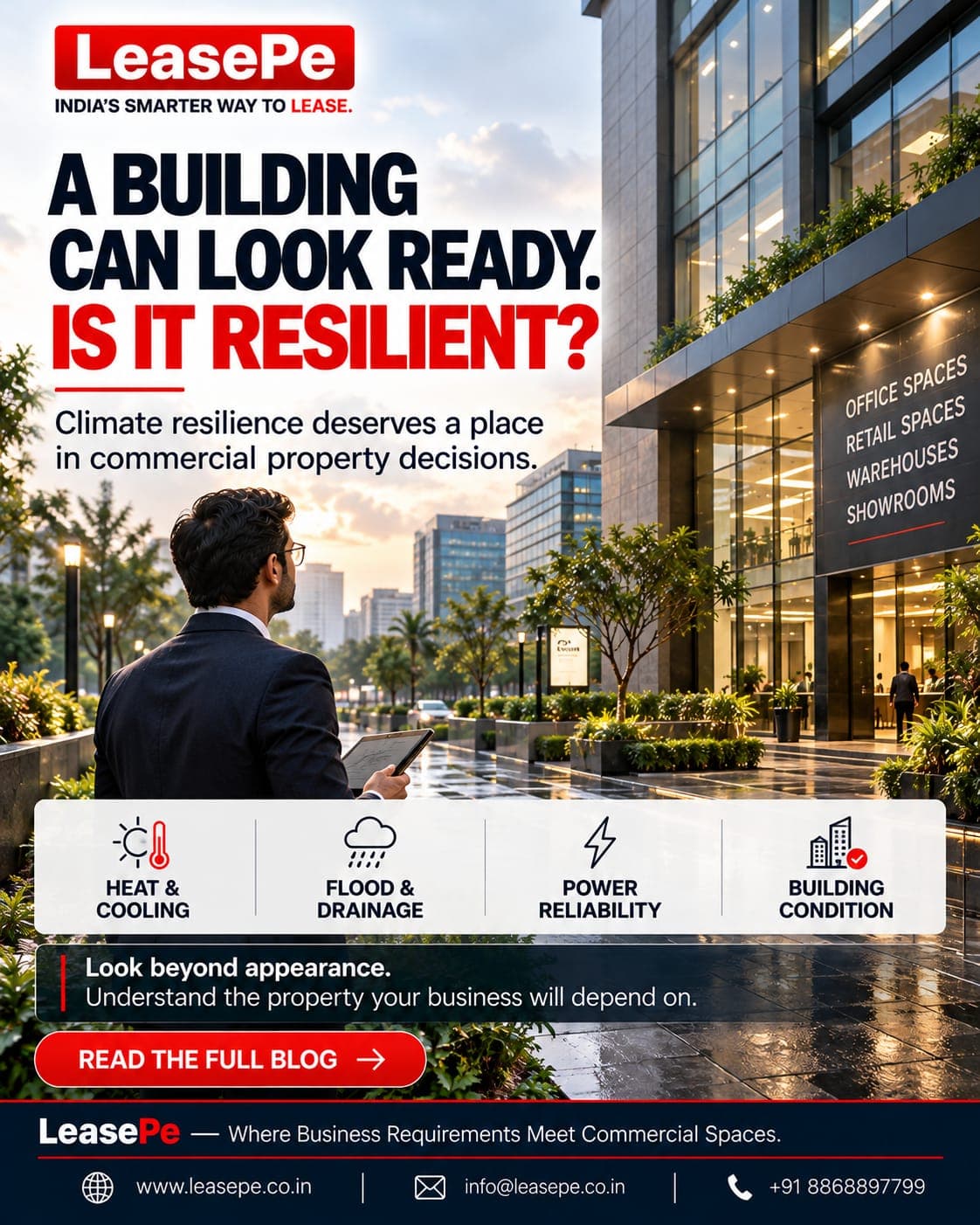
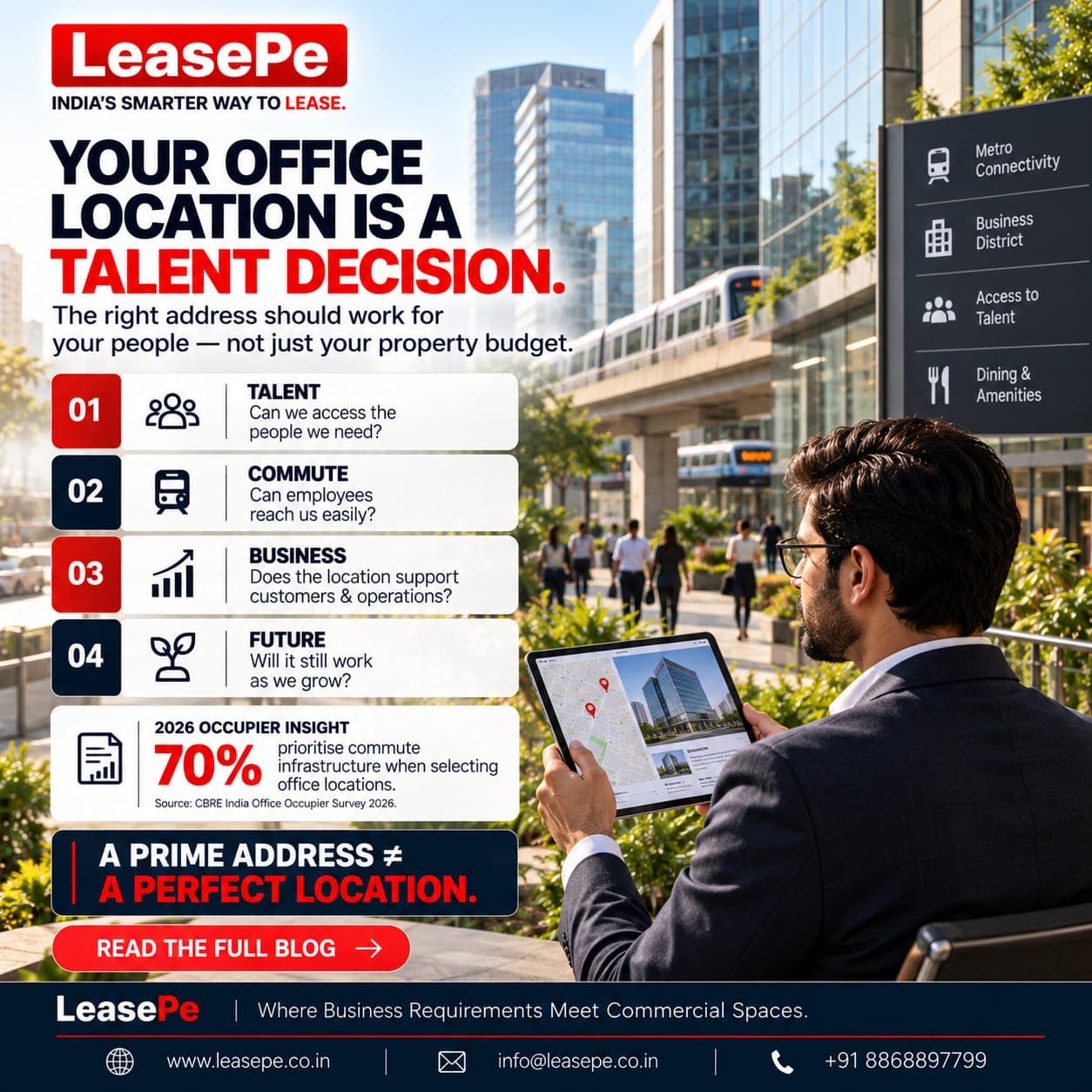
Discover how commercial property influences customer trust, employee experience, brand perception and business performance—and what businesses should evaluate beyond rent and area.
8 October 2026Admin10 min read
THE SPACE PEOPLE REMEMBER
How Commercial Property Shapes Customer Trust, Brand Perception & Business Experience
This is different from your earlier “Brand Intelligence” post. That post asks whether a property is relevant to a brand. This article asks what happens after the brand occupies the space—how the physical environment influences how people perceive the business.
THE SPACE PEOPLE REMEMBER
How Commercial Property Shapes Customer Trust, Brand Perception & Business Experience
A customer may forget the exact rent a business pays.
They may never know the lease terms.
They probably don't know the property's carpet area.
Was it easy to find?
Did the entrance feel welcoming?
Was the space comfortable?
Did the location feel convenient?
Did the environment feel trustworthy?
Did the business look established?
Did the experience match what the brand promised?
This is the overlooked side of commercial real estate.
A commercial property is not only where a business operates.
For many businesses, it becomes part of how the business is experienced.
And that makes property a business decision—not simply a real-estate decision.
1. Customers Don't Experience “Square Feet”
A property listing may say:
3,500 sq. ft.
Ground floor
Main road
Parking available
But customers don't experience those specifications as numbers.
They experience:
Can I find it?
Can I enter easily?
Does it feel accessible?
Does the environment feel right?
Do I trust this business?
This is an important distinction.
A property has technical attributes.
A customer experiences emotional outcomes.
And those outcomes can influence whether someone stays, explores, returns—or leaves.
2. The First Impression Starts Before the Door
For a physical business, the customer experience can begin several minutes before entering.
They may notice:
the surrounding street
signage
visibility
traffic
parking
entrance
neighbouring businesses
building appearance
lighting
pedestrian movement
By the time the customer reaches the entrance, they may already have formed an initial opinion.
This is why location and experience are connected.
A highly visible, accessible property can reduce friction.
For retailers especially, current market commentary from Cushman & Wakefield shows continued demand for prominent, high-visibility locations, while its Q3 2026 analysis notes increasing emphasis on experience-led retail destinations and differentiated consumer experience.
Cushman & Wakefield +1
3. The Psychology of “Does This Place Feel Right?”
People rarely evaluate commercial environments through a conscious checklist.
They don't normally walk into a showroom and think:
“The spatial configuration is excellent and the environmental design supports perceived brand equity.”
They think:
I like this place.
Or:
Something feels off.
That response can be influenced by dozens of environmental cues:
cleanliness
lighting
crowding
noise
layout
navigation
visibility
comfort
aesthetics
accessibility
The customer may not consciously identify every factor.
But the brain is continuously processing them.
4. The Property Becomes Part of the Brand
Imagine two businesses selling similar products.
BRAND A
Good product.
Poorly accessible location.
Confusing entrance.
Limited parking.
Crowded environment.
BRAND B
Similar product.
Easy access.
Clear signage.
Comfortable environment.
Convenient customer journey.
The difference isn't necessarily the product.
It may be the environment surrounding the product.
This is why commercial property can become part of brand positioning.
A premium brand may need a space that communicates:
quality + consistency + confidence.
A neighbourhood business may prioritise:
convenience + familiarity + accessibility.
A healthcare business may prioritise:
trust + privacy + comfort.
A warehouse may care much less about customer aesthetics and far more about:
movement + efficiency + access.
There is no universal “perfect property.”
There is only:
A property that communicates the right experience for the business.
5. The Same Property Can Mean Different Things to Different Businesses
Consider a property on a busy main road.
For a fashion retailer:
High visibility = opportunity.
For a consulting office:
Noise and congestion = possible inconvenience.
For an F&B business:
Footfall = potential demand.
For a warehouse:
Traffic congestion = operational friction.
The physical property hasn't changed.
The meaning of the property has changed.
This is why commercial property decisions need to be interpreted through the business model.
6. Customer Friction Is a Real Business Cost
Let's imagine a customer wants to visit a business.
They search for the address.
The location is difficult to identify.
They drive around.
Parking is unavailable.
The entrance isn't obvious.
They finally arrive—but the experience has already required effort.
None of these problems may appear in the rent calculation.
But they can affect customer experience.
This is the concept of friction.
The more unnecessary effort a customer has to make, the more opportunities there are for dissatisfaction or abandonment.
For customer-facing businesses, therefore:
Accessibility isn't just a property feature.
It can become a customer-experience feature.
Cushman & Wakefield's current retail advisory positioning similarly connects location strategy with local demographics, culture, customer attraction and long-term brand success.
Cushman & Wakefield
7. The Employee Experiences the Property Differently
Customers are not the only people interacting with commercial space.
Employees experience it every working day.
Their questions are different:
Can I reach the office easily?
Is there reliable transport?
Is parking manageable?
Does the workplace support how I work?
Does it feel comfortable?
Can I collaborate?
Can I concentrate?
The workplace therefore becomes part of the employee experience.
Colliers' 2026 workplace research describes a shift from measuring workplaces mainly by utilisation toward asking how the workplace makes employees feel, with greater emphasis on experience, wellbeing, collaboration and digitally enabled environments.
Colliers +1
8. Space Can Communicate Company Culture
Consider two offices.
OFFICE A
Rows of desks.
Minimal common areas.
Limited collaboration space.
OFFICE B
Collaborative zones.
Meeting areas.
Quiet spaces.
Technology-enabled infrastructure.
Employee amenities.
Neither is automatically better.
The important question is:
Which environment supports the company's way of working?
A fast-growing technology company may value collaboration.
A legal practice may need privacy.
A training organisation may need flexible learning areas.
A healthcare business may need controlled movement and confidentiality.
The physical environment can therefore reinforce the organisation's operating culture.
9. “Premium” Is Not Just Expensive
One of the biggest misunderstandings in commercial real estate is equating premium with price.
A high-rent property is not automatically a premium experience.
CBRE's 2026 research describes a broader “flight to quality,” with occupiers increasingly prioritising premium assets, experience and operational quality rather than treating price as the sole criterion.
CBRE India +1
10. The “Experience Gap” Between Listing and Reality
Here is another important problem.
A property listing might look excellent online.
Beautiful photographs.
Perfect description.
Great specifications.
But when someone visits:
The road feels different.
The surroundings feel different.
The access feels different.
The building feels different.
The customer journey feels different.
This is why:
Digital discovery creates expectations. Physical experience confirms or destroys them.
A serious commercial property evaluation should therefore go beyond the listing.
It should ask:
What will the actual user experience be?
11. Think in Journeys, Not Rooms
Instead of evaluating a property only room by room, evaluate it as a journey.
This approach reveals problems that a conventional property checklist can miss.
A property may look excellent on paper.
But if the journey is inefficient, the space may not perform as expected.
12. Different Businesses Have Different “Moments That Matter”
Not every part of a property matters equally.
For a retailer:
First visibility → entrance → display → checkout
For a restaurant:
Arrival → ambience → seating → service
For an office:
Arrival → work environment → collaboration → amenities
For a warehouse:
Vehicle entry → loading → movement → storage
For a clinic:
Arrival → reception → privacy → consultation
This is where property selection becomes more sophisticated.
Instead of asking:
Is the property good?
ask:
Does the property support the moments that matter most to this business?
13. A Property Can Strengthen or Weaken Trust
Trust is especially important in businesses where customers are making high-value or sensitive decisions.
The surrounding environment can influence the customer's initial perception.
A well-maintained, accessible and professionally presented environment can create one signal.
A poorly maintained or confusing environment can create another.
This doesn't mean customers automatically trust a business because its property looks expensive.
It means:
The environment becomes one of the many signals people use to form impressions.
14. The Property Should Match the Promise
This may be the most important principle in the article.
If a brand promises:
PREMIUM
The environment should support that promise.
If it promises:
CONVENIENCE
Access should support that promise.
If it promises:
COMMUNITY
The location and surrounding ecosystem should support that promise.
If it promises:
EFFICIENCY
The operational layout should support that promise.
If the brand promise and physical environment contradict each other, customers can experience a subtle
form of inconsistency.
And consistency matters.
15. Don't Overdesign the Property. Design for the Business.
There is another trap.
Businesses can become obsessed with making a property visually impressive.
But visual appeal alone isn't enough.
A beautiful office with poor acoustics may frustrate employees.
A premium showroom with poor parking may frustrate customers.
A modern warehouse with inadequate loading access may frustrate operations.
A visually impressive space that doesn't support the business is still a poor business space.
Form should serve function.
16. What Should Businesses Evaluate?
When evaluating a commercial property, add an Experience Layer to the normal property analysis.
ACCESS
How easily can people reach it?
ARRIVAL
What does the first few minutes feel like?
NAVIGATION
Can customers, employees and visitors move through it easily?
COMFORT
Does the environment support the intended use?
IDENTITY
Does the space feel consistent with the brand?
OPERATIONS
Can the business function efficiently?
FUTURE
Can the experience remain strong as the business grows?
This creates a more human evaluation of commercial space.
17. What Property Owners Should Understand
Owners often think:
The property is vacant. I need to find a tenant.
A stronger perspective is:
What kind of business would experience the greatest value from this property?
A ground-floor corner space may be particularly relevant to a customer-facing brand.
A large floor plate may work better for a particular office format.
A property with strong loading access may be more valuable to logistics-oriented users.
The goal isn't to make every property attractive to everyone.
It's to make the property's real strengths visible to the businesses that can use them.
18. What LeasePe Can Do Differently
This is where the concept becomes relevant to LeasePe.
The future of commercial leasing is not simply:
Property → Listing → Tenant
It can become:
Business → Experience Requirement → Property Fit → Better Decision
A business doesn't just need:
3,500 sq. ft.
It may need:
3,500 sq. ft. + visibility + parking + customer access + brand environment + operational efficiency.
That is a much richer requirement.
And it creates a much richer property conversation.
LeasePe's existing model already focuses on connecting commercial property owners with business requirements across shops, showrooms, offices, warehouses, godowns, factories and commercial land.
LeasePe +1
The next step in that thinking is understanding not only what space a business needs, but what experience that space needs to create.
19. A New Way to Evaluate Commercial Property
Before saying:
“This property is good.”
Ask:
Good for whom?
Before saying:
This is a premium location.
Ask:
Premium for which business model?
Before saying:
This property has everything.
Ask:
Does it support the moments that matter?
And before signing:
What will customers, employees and operators actually experience here?
Those questions can reveal more than another property specification sheet.
Final Thought
Commercial real estate is often discussed in terms of:
area, rent, location, floor and specifications.
But businesses operate in spaces experienced by people.
Customers.
Employees.
Managers.
Visitors.
Suppliers.
Partners.
Those people don't experience square feet.
They experience:
access, movement, comfort, convenience, identity and trust.
That's why the right commercial property isn't merely a property that fits the numbers.
It's a space that fits the people, the business and the experience the brand wants to create.
Because the best commercial space isn't just occupied.
It's experienced.
LeasePe
Where Business Requirements Meet Commercial Spaces.
For businesses searching for commercial space and owners looking to connect with relevant business requirements.
🌐 www.leasepe.co.in
📧 info@leasepe.co.in
📞 +91 8868897799
commercial property customer experience
commercial property and customer experience
commercial space and brand perception
commercial property for business
commercial real estate customer experience
commercial property selection India
retail property customer experience
commercial space selection
commercial leasing India
business location and customer experience
commercial property brand experience
commercial real estate India
/blog/commercial-property-customer-experience-brand-perceptioncommercial property customer experiencecommercial property and customer experience commercial space and brand perception commercial property for business commercial real estate customer experience commercial property selection India retail property customer experience commercial space selection commercial leasing India business location and customer experience commercial property brand experience commercial real estate India
Why do businesses reject seemingly good commercial properties? Explore 7 decision-friction points that influence commercial property leasing decisions in India.