What Makes a Commercial Property Listing Brand-Ready in India?
real estate
What Makes a Commercial Property Listing Brand-Ready in India?
Learn what information makes a commercial property listing useful to growing brands—from location and area to frontage, parking, access and documentation.
24 September 2026Admin7 min read
Commercial Property Listing Checklist: What Brands Look For | LeasePe
commercial property listing
commercial property for lease, commercial space for rent, property for brands, retail property for lease, commercial real estate India, commercial leasing, property listing checklist
What Makes a Commercial Property Listing Brand-Ready in India?
Finding a commercial property is no longer simply about putting up a “For Lease” board.
For a growing business, the first question is not just “How much is the rent?
It is:
Does this property actually fit our business requirement?
Location, usable area, frontage, accessibility, parking, utilities, property type and documentation can all influence whether a commercial space moves from an initial search to a serious site visit.
That makes the quality of property information extremely important.
At LeasePe, commercial properties can be registered with details that help businesses and brands discover spaces according to their requirements. The platform supports offices, shops, showrooms, warehouses, godowns, factories, industrial spaces and commercial land.
LeasePe +1
So, what should a business actually see in a good commercial property listing?
1. Start With the Location
A property can have the right area and rent but still be unsuitable if the location doesn't fit the business.
For retail businesses, location analysis can involve:
Customer catchment
Nearby residential and commercial areas
Road connectivity
Visibility
Accessibility
Nearby businesses
Parking availability
LeasePe's retail site-selection guide highlights catchment, demographics, accessibility, visibility, competitor density and parking as important considerations in evaluating retail locations.
LeasePe
A useful listing should therefore make the location easy to understand—not just mention the city.
Instead of:
Commercial property available in Agra.
A more useful listing could communicate:
Main-road commercial property near a major retail and residential catchment.
The more relevant context a business has, the easier it becomes to shortlist a property.
2. Clearly Mention the Property Type
Businesses have very different space requirements.
A retailer may need a shop or showroom.
A logistics company may need a warehouse or godown.
A corporate team may need an office.
A manufacturer may require a factory or industrial space.
Commercial land may serve an entirely different business requirement.
LeasePe currently categorizes commercial opportunities across offices, shops, showrooms, warehouses, godowns, factories, industrial properties and commercial land.
LeasePe
The right property type helps the right requirement find the right space.
3. Area Is Important—but Usable Area Matters
"2,000 sq. ft.” alone doesn't tell a business everything it needs to know.
A serious commercial requirement may also need clarity around:
Carpet area
Built-up area
Floor
Floor plate
Loading/unloading area
Common areas
Storage area
Outdoor space
For example, a retail brand may evaluate the usable selling area differently from a warehouse operator evaluating storage capacity.
Good property data makes comparison easier.
4. Frontage Can Matter for Retail
For a retail property, the space facing the road can be just as important as the total area.
A business may want to understand:
How visible is the property from the road?
Important listing information can include:
Frontage width
Main-road exposure
Signage opportunity
Entrance position
Ground-floor availability
Visibility from approaching traffic
LeasePe's retail site-selection content specifically discusses frontage and visibility as part of the location evaluation process.
LeasePe
5. Accessibility Should Be Easy to Understand
A commercial property isn't useful simply because it exists at a particular address.
Businesses also need to consider how customers, employees, suppliers and logistics vehicles reach it.
A useful listing can mention:
Main-road access
Road width
Entry and exit
Nearby major roads
Public transport access
Loading access
Vehicle movement
Distance from relevant landmarks
For logistics and industrial requirements, access can become especially important because vehicle movement and loading operations are part of everyday business activity.
6. Don't Hide the Parking Details
Parking is often treated as a secondary feature.
For many businesses, it isn't.
Retail customers may need convenient parking.
Office employees may require designated parking.
Showrooms may need customer and display-vehicle space.
Warehouses may require vehicle and loading access.
A commercial listing should therefore answer:
“What parking/access arrangements does this property actually have?”
Clear information saves businesses from unnecessary site visits.
7. Show the Technical Details
A commercial property should be presented as a business asset, not just a photograph.
Depending on the property, useful technical information may include:
Power availability
Water supply
Lift
Fire-safety provisions
HVAC possibilities
Loading facilities
Ceiling height
Structural configuration
Internet connectivity
Backup power
Washroom facilities
The exact requirements will vary by business.
For example, LeasePe's existing landlord guide discusses different technical requirements for banks, F&B businesses, corporate offices and high-street retailers.
LeasePe
The lesson: different businesses evaluate different specifications.
8. Documentation Builds Leasing Readiness
A serious business does not want to discover documentation issues after spending time on a property visit.
Depending on the property and transaction, owners may need to keep relevant documentation and approvals ready for due diligence.
LeasePe's existing landlord guidance discusses items such as title documentation, property-tax records, occupancy-related documentation and applicable NOCs.
LeasePe
This doesn't mean every property requires the same document set.
It means one thing:
Documentation should be treated as part of property readiness.
9. Use Good Images—but Don't Depend on Images Alone
A beautiful property photograph can attract attention.
But photographs cannot answer every business question.
A stronger commercial listing combines:
Visual information + property specifications + location context + commercial details.
Useful visuals can include:
Exterior frontage
Interior
Entrance
Parking
Road view
Floor plan
Loading area
Surrounding commercial environment
This helps a business decide whether the property deserves a closer look.
10. Make the Requirement Matchable
This is where structured property information becomes especially useful.
Imagine a business requirement:
City: Agra
Property: Retail space
Area: 2,500–4,000 sq. ft.
Location: High-visibility commercial area
Parking: Required
Budget: Defined range
Now compare that with an unstructured listing:
“Shop available. Call for details.”
The second listing may have a suitable property—but the information makes it harder to determine the fit.
LeasePe's current process is designed around this owner-and-business connection: owners register properties, businesses submit requirements or search listings, LeasePe reviews and matches relevant opportunities, and the team supports coordination through visits and owner connection.
LeasePe
The Commercial Property Listing Checklist
Before presenting a property to potential business tenants, consider whether the listing clearly
answers:
Requirement
What to Show
📍 Location
City, area, road, landmark
🏢 Property Type
Office, shop, showroom, warehouse, etc.
📄 Documentation
Relevant ownership/approval information
💰 Commercial Terms
Rent and applicable terms
📸 Visuals
Clear property photographs/floor plans
From “Vacant Property” to “Business Opportunity”
The commercial leasing process becomes more efficient when a property is presented around business requirements, rather than simply advertised as vacant space.
That is the idea behind LeasePe.
For property owners:
Register your commercial property and provide the information businesses need to evaluate it.
For brands and businesses:
Share your location, property type, area and budget requirements and explore suitable commercial spaces.
LeasePe currently supports property discovery, requirement matching, site-visit coordination and owner-brand connections.
LeasePe
Final Thought
A commercial property listing is more than an advertisement.
It is the first layer of information between a property owner and a potential business tenant.
The clearer the information, the easier it becomes to understand:
Where is it?
What can it support?
Who could it suit?
Is it ready?
Because the goal isn't simply to find a vacant property.
It's to find the right commercial fit.
LeasePe
India's Smarter Way to Lease.
📞 +91 8868897799
🌐 www.leasepe.co.in
📧 info@leasepe.co.in
Have a commercial property?
List it with LeasePe and present your space to relevant business requirements.
Looking for commercial space?
Tell LeasePe what your business needs.
Explore commercial leasing with LeasePe →
LeasePe
Suggested featured-image headline
Is Your Commercial Property Brand-Ready?
6 things businesses look for before they shortlist a space.
This topic gives LeasePe a new SEO pillar around “property readiness + structured listings” without repeating the existing retail-site-selection and landlord-guide articles.
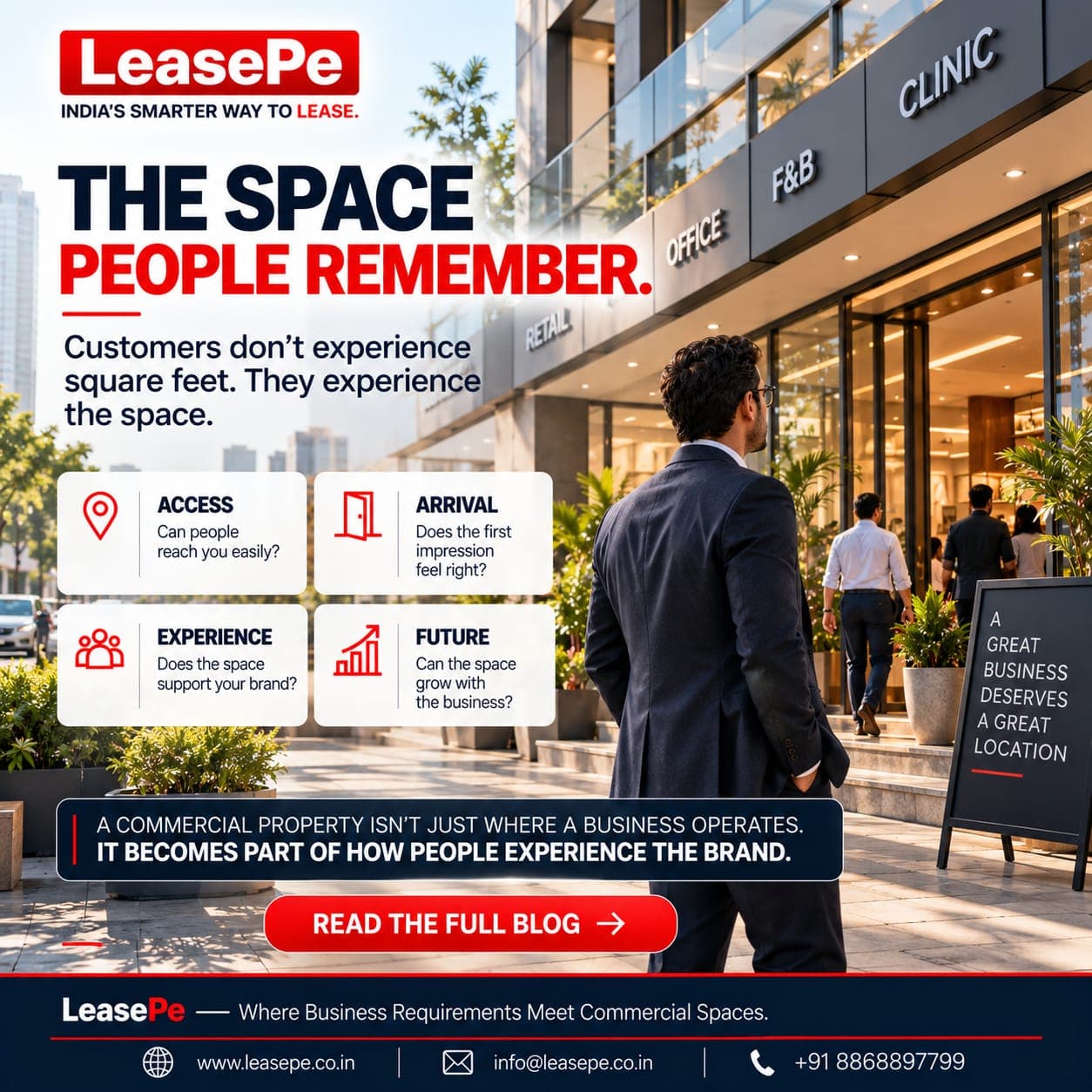
Discover how commercial property influences customer trust, employee experience, brand perception and business performance—and what businesses should evaluate beyond rent and area.