Renew or Relocate? Commercial Lease Renewal vs Relocation Guide
real estate
Renew or Relocate? Commercial Lease Renewal vs Relocation Guide
Should your business renew its commercial lease or relocate? Use this practical decision framework to compare rent, fit-out costs, location, operations, flexibility and future business needs.
5 October 2026Admin9 min read
Renew or Relocate? How Businesses Should Decide When a Commercial Lease Is Ending
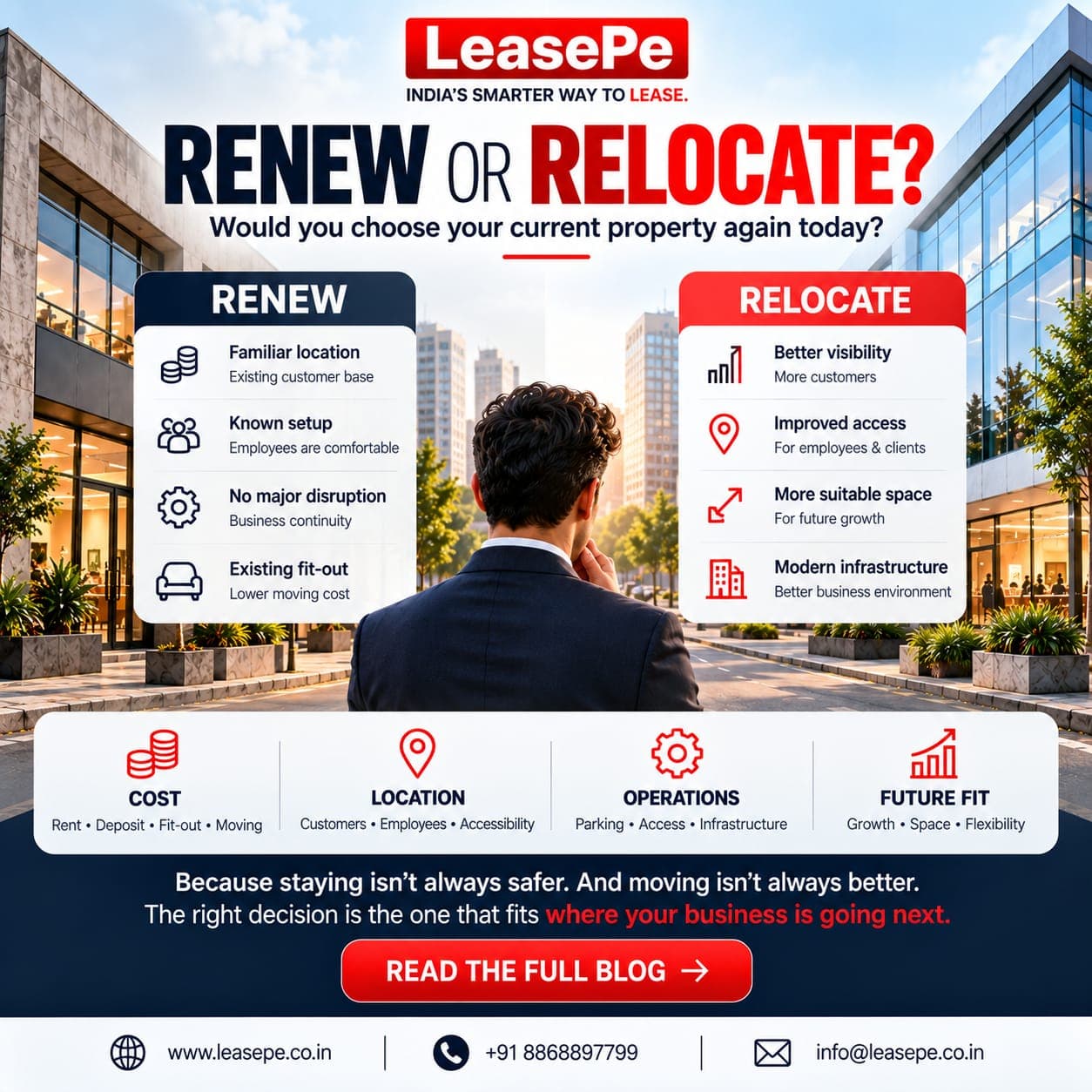
A commercial lease nearing its expiry creates a deceptively simple question:
Should we renew—or should we move?
At first glance, the decision appears financial.
Is the new rent affordable?
Is another property cheaper?
How much will relocation cost?
But experienced occupiers know the real decision is much bigger.
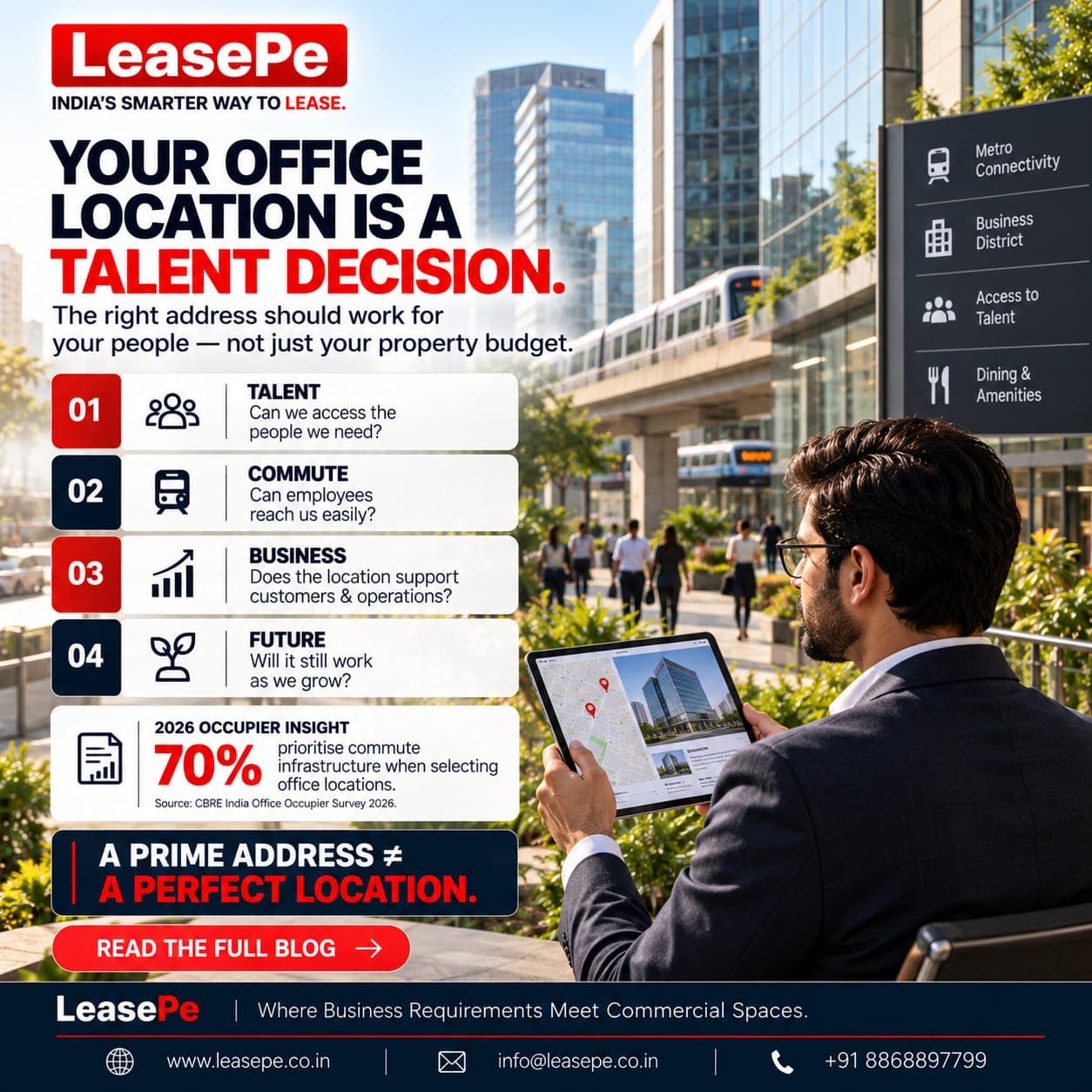
A location affects employees, customers, operations, brand visibility, logistics, productivity and future growth.
At the same time, staying in the same property has its own hidden advantages: familiarity, continuity, existing fit-out and lower disruption.
That is why renewal vs relocation is not simply a rent comparison.
It is a business decision involving cost, friction, risk and future fit.
And in 2026, this decision is becoming increasingly relevant as occupiers rethink their portfolios around expansion, flexibility and quality. CBRE reports that nearly half of surveyed Indian occupiers plan to expand their real-estate footprint through expansion or consolidation, while around a quarter expect to renew existing leases over the next two years.
CBRE India
1. The First Question Should Not Be “What Is the New Rent?”
This is one of the biggest mistakes businesses make.
A company receives a renewal proposal and immediately compares:
Current rent → New rent
But the better comparison is:
Cost of Staying vs Cost of Moving
Staying may involve:
Higher rent
Revised lease terms
Additional fit-out
Maintenance changes
Parking or facility costs
Limited expansion potential
Moving may involve:
New rent
Security deposit
Brokerage or transaction costs
New interiors
Moving expenses
Downtime
New signage and branding
Employee disruption
Customer communication
Operational transition
The cheapest rent is therefore not automatically the cheapest decision.
The real question is:
Which option creates the better business outcome over the next lease cycle?
2. The Psychology of Staying: “We Already Know This Place”
There is a powerful psychological force behind lease renewals:
The Status Quo Effect
People often prefer an existing situation simply because it is familiar.
The current property already has:
Known access routes
Familiar employees
Existing customers
Established vendors
Existing interiors
Known building management
Existing operational processes
Moving creates uncertainty.
And businesses, like people, often perceive uncertainty as risk.
This can produce a dangerous thought:
“It may not be perfect, but at least we know what we have.”
That may be rational.
But it can also become inertia disguised as stability.
3. The Psychology of Moving: “Maybe the Next Space Will Be Better”
Relocation has the opposite psychological effect.
A new property creates the possibility of:
Better visibility
Better access
Better employee experience
Better infrastructure
Better brand positioning
Better operational efficiency
More suitable space
But businesses can also become overly optimistic.
A beautiful new property can create a novelty effect.
The space looks better.
The building feels newer.
The location sounds more premium.
But the business question remains:
Does the new property actually perform better for your business?
A visually impressive property that creates operational problems can be worse than an ordinary-looking property that works extremely well.
4. Compare Five Things Before You Decide
Instead of comparing only rent, evaluate both options across five dimensions.
Calculate the total occupancy cost, not simply monthly rent.
② Operational Fit
Ask:
Does the property make daily operations easier or harder?
For example:
Retail
Customer access
Visibility
Parking
Footfall
Loading/unloading
Office
Employee commute
Public transport
Workspace configuration
Amenities
Expansion capability
Warehouse
Truck access
Loading infrastructure
Clear height
Storage configuration
Connectivity
Manufacturing
Power
Industrial access
Labour availability
Logistics
Site configuration
The same property can be excellent for one business and completely unsuitable for another.
5. Location Should Be Evaluated Through Business Impact
A common mistake is asking:
“Is the new location better?”
Instead ask:
“Is the new location better for our business model?”
A location can be more expensive but generate stronger commercial value.
Another location can be cheaper but create:
Longer employee travel
Lower customer accessibility
Higher logistics costs
Reduced visibility
Weaker catchment
Operational inefficiency
CBRE's 2026 India office research shows how important occupier preferences have become around quality and flexibility; its Q3 2026 data also shows continued strong demand for office space, with 9M leasing reaching a record 66.4 million sq. ft.
CBRE India
The market is active.
But market activity does not mean every available property is equally suitable.
6. The Hidden Cost of Relocation: Business Disruption
This is where many relocation calculations fail.
The spreadsheet may calculate:
New rent + deposit + interiors + moving
But what about the human side?
A relocation can affect:
Employee routines
Customer familiarity
Vendor relationships
Business continuity
Internal productivity
Sales activity
Brand communication
For some businesses, disruption may be manageable.
For others, even a short interruption can be expensive.
This is why the right question is not:
“Can we afford to move?”
It is:
“Can the business absorb the transition?”
7. The Hidden Cost of Staying: Opportunity Cost
Renewal feels safer because there is less disruption.
But staying can also have a cost.
Ask:
Is the business outgrowing the space?
Is parking becoming inadequate?
Is the location losing relevance?
Is the building infrastructure aging?
Is customer accessibility declining?
Are employees struggling with the location?
Is the current layout limiting productivity?
Is expansion becoming difficult?
Could another location significantly improve the business?
If the answer to several of these is yes, renewal may simply postpone a decision that eventually has to be made.
8. Fit-Out Costs Can Change the Entire Decision
This is particularly important in the current market.
CBRE's Asia Pacific Leasing Market Sentiment Index reported that more occupiers were evaluating renewal versus relocation decisions amid concerns around rising fit-out costs.
CBRE India
Consider two scenarios:
OPTION A — RENEW
Rent: ₹2.5 lakh/month
Additional fit-out:
₹10 lakh
Minimal disruption
OPTION B — RELOCATE
Rent: ₹2.2 lakh/month
New fit-out: ₹35 lakh
Moving + transition costs:
₹8 lakh
Option B looks cheaper when you compare rent.
But once the entire transition is considered, the answer may change.
This is why lease decisions should be evaluated over the full decision horizon—not just month one.
9. Don't Fall Into the “Sunk Cost” Trap
Another psychological mistake is:
“We already spent so much on this property, so we should stay.”
That money has already been spent.
The relevant question is:
What decision creates the best future outcome from today onward?
Existing interiors, branding and infrastructure should absolutely be considered—but as future savings,
not as a reason to remain in an unsuitable location indefinitely.
This distinction helps businesses separate:
Past investment
from
Future value.
10. A Simple Renew vs Relocate Scorecard
Before making the final decision, score both options from 1–5.
Factor
Renew
Relocate
Total occupancy cost
/5
/5
Location suitability
/5
/5
Customer accessibility
/5
/5
Employee accessibility
/5
/5
Operational efficiency
/5
/5
Parking & access
/5
/5
Infrastructure
/5
/5
Brand visibility
/5
/5
Expansion potential
/5
/5
Flexibility
/5
/5
Business disruption
/5
/5
Future suitability
/5
/5
Then ask one final question:
Which option gives the business a stronger position for the next 3–5 years?
That question is often more useful than:
“Which property has the lower rent?”
11. When Renewal May Make More Sense
Renewal can be attractive when:
The location performs well
Customers already know the address
Employees are comfortable with the location
Existing infrastructure works
Relocation would create significant disruption
The landlord offers commercially reasonable terms
The property still supports growth
Fit-out investment can continue to be used
The business does not need a major operational change
In these circumstances, negotiating a better renewal structure may create more value than moving.
12. When Relocation May Make More Sense
Relocation deserves serious consideration when:
The business has outgrown the property
Location no longer supports the customer base
Employee accessibility is poor
Parking/access has become a problem
Operations are inefficient
The property limits expansion
Infrastructure no longer meets requirements
A better micro-market has emerged
The current lease terms have become unattractive
A new property provides substantially better future fit
The important word is substantially.
Moving simply because another property looks slightly better may not justify the disruption.
13. Don't Wait Until the Lease Is About to Expire
One of the biggest strategic mistakes is starting the evaluation too late.
Businesses should ideally begin reviewing the decision well before the expiry date.
instead of:
Expiry approaching → Panic → Renew immediately
Colliers' tenant-representation approach similarly treats renewal, relocation and refurbishment as
structured processes requiring needs evaluation, market analysis and attention to potential hurdles.
Colliers
14. The Better Way to Think About Commercial Leasing
The traditional question is:
“Should we renew this property?”
A stronger business question is:
“What does our business need from its next location?”
That changes everything.
You stop evaluating only the existing property.
You start evaluating the future requirement.
For example:
TODAY
3,000 sq. ft.
20 employees
Limited parking
Current customer base
NEXT LEASE CYCLE
5,000 sq. ft.
40 employees
Higher customer volume
More parking
Better access
Room for expansion
The right answer may no longer be the property that worked three years ago.
Business growth can change property requirements.
15. The LeasePe Perspective
Commercial leasing should not begin with:
“What properties are available?”
It should begin with:
“What does the business actually need?”
That requirement can include:
Location + Property Type + Area + Budget + Access + Parking + Visibility + Operations + Future Growth
Once the requirement is clear, businesses can evaluate whether the existing property still fits—or whether it is time to explore alternatives.
LeasePe connects commercial property owners with business requirements across offices, shops, showrooms, warehouses, godowns, factories and commercial land, with a focus on property discovery, requirement matching and assisted coordination.
LeasePe
Final Thought
Renewing is not always safer.
Relocating is not always better.
The right decision depends on future business fit.
A commercial property should not simply work for the business it was three years ago.
It should make sense for where the business is going next.
Before you renew, ask:
“Would we choose this property again today?”
If the answer is yes, negotiate from knowledge.
If the answer is no, start exploring alternatives before the deadline forces the decision.
LeasePe — Where Business Requirements Meet Commercial Spaces.
For Businesses: Tell us what space your business needs.
For Property Owners: List your commercial property and connect with relevant business requirements.
Discover how commercial property influences customer trust, employee experience, brand perception and business performance—and what businesses should evaluate beyond rent and area.