Coworking vs Managed Office vs Traditional Lease: 2026 Guide
Evaluating coworking vs managed office vs traditional lease? Discover which workspace model maximizes your company's financial runway in 2026 with LeasePe.
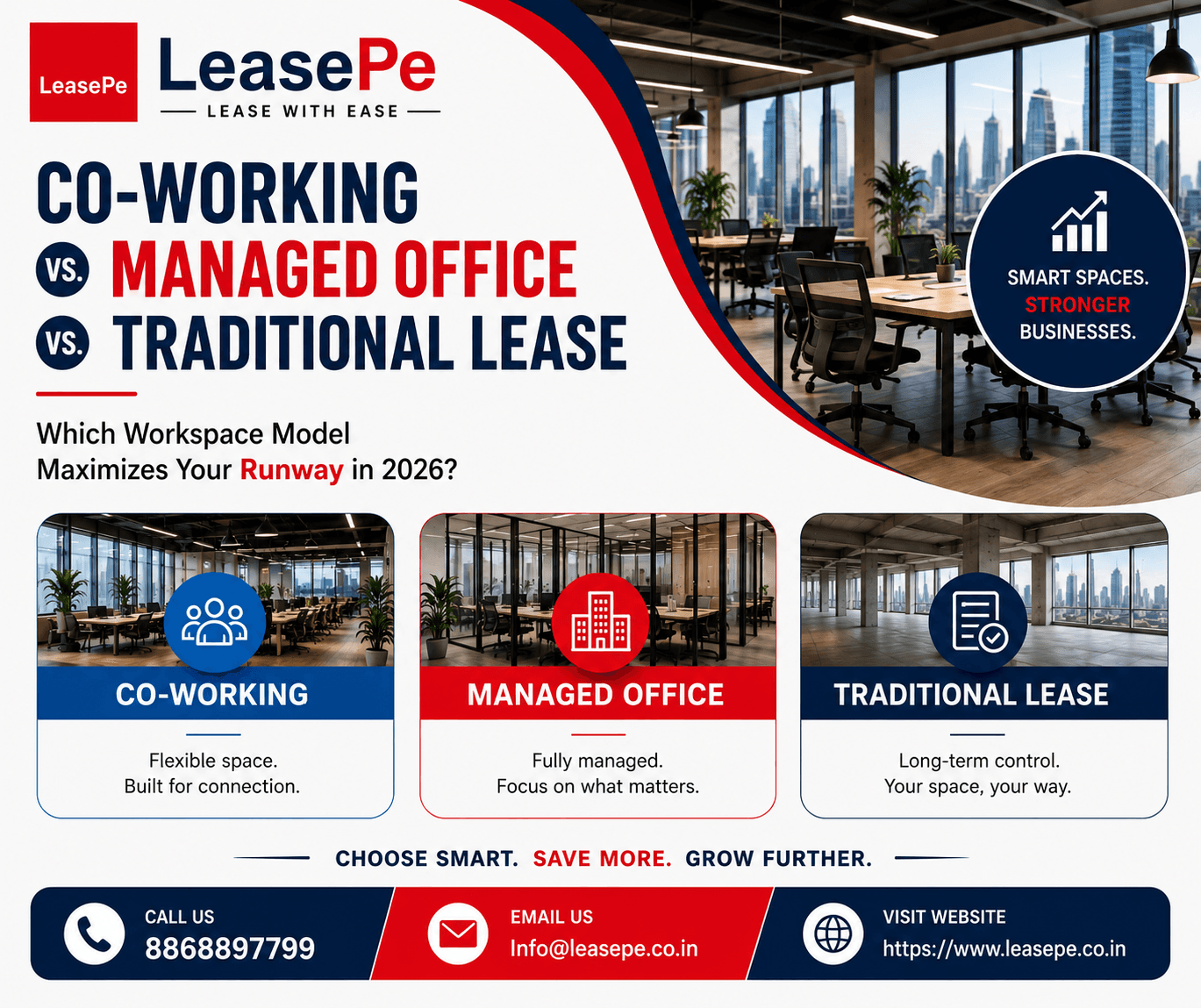
Understanding Co-Working vs. Managed Office vs. Traditional Lease: Which Workspace Model Maximizes Your Runway in 2026?
Signing a commercial real estate lease used to be a predictable, paint-by-numbers milestone. Your company raised a round of capital, calculated a multi-year hiring projection, secured a bare-shell space, spent three painful months managing general contractors, and locked yourself into a rigid 5-to-9-year legal commitment.
In 2026, that legacy playbook is dead.
Driven by the explosive rise of Global Capability Centers (GCCs) expanding into Tier-2 Indian micro-markets and the stabilization of dynamic hybrid work models, agility has completely replaced vanity. In fact, latest commercial real estate data reveals that flexible workspaces now command a historic 24% of all gross office leasing across India’s top tier cities.
For modern startup founders, enterprise product managers, and corporate finance directors, your workspace strategy is no longer a simple facility decision—it is a critical asset allocation choice that directly impacts your cash runway. The most expensive real estate mistake you can make this year is locking valuable liquid capital into physical brick-and-mortar infrastructure before your business achieves headcount certainty.
When evaluating your next corporate footprint, you are choosing between three fundamentally different operating platforms: the Traditional Commercial Lease, the Co-Working Space, and the hybrid Managed Office Space. Navigating these shifting models seamlessly is exactly why modern enterprises use LeasePe to optimize their workplace procurement.
Here is the definitive, data-backed strategic breakdown to help you choose the right model for your business lifecycle.
1. The Core Infrastructure Models Defined
Traditional Commercial Lease: The Heavy Bespoke Anchor A traditional lease is a direct contract with a property owner for a dedicated physical space—typically delivered as a bare shell or warm shell. You hold 100% architectural control, but you also inherit 100% of the operational risk.
The Burden: You must independently finance the entire design layout, mechanical, electrical, and plumbing (MEP) infrastructure, internet routing, and security arrays.
The Inline Reality: It requires heavy CapEx (Capital Expenditure)—the upfront funds spent to acquire and upgrade physical assets—which becomes permanently sunk into a property you do not own.
Co-Working Space: The High-Velocity Shared Utility Co-working spaces are plug-and-play environments where your team operates out of hot desks or small private cabins within a highly shared, community-managed perimeter.
Keep reading
Related insights

real estate
Commercial Property Climate Resilience: What Businesses Should Know | LeasePe
Discover how heat, flooding, power reliability and building resilience can affect commercial property leasing in India. Learn what businesses should evaluate before choosing a space.
real estate
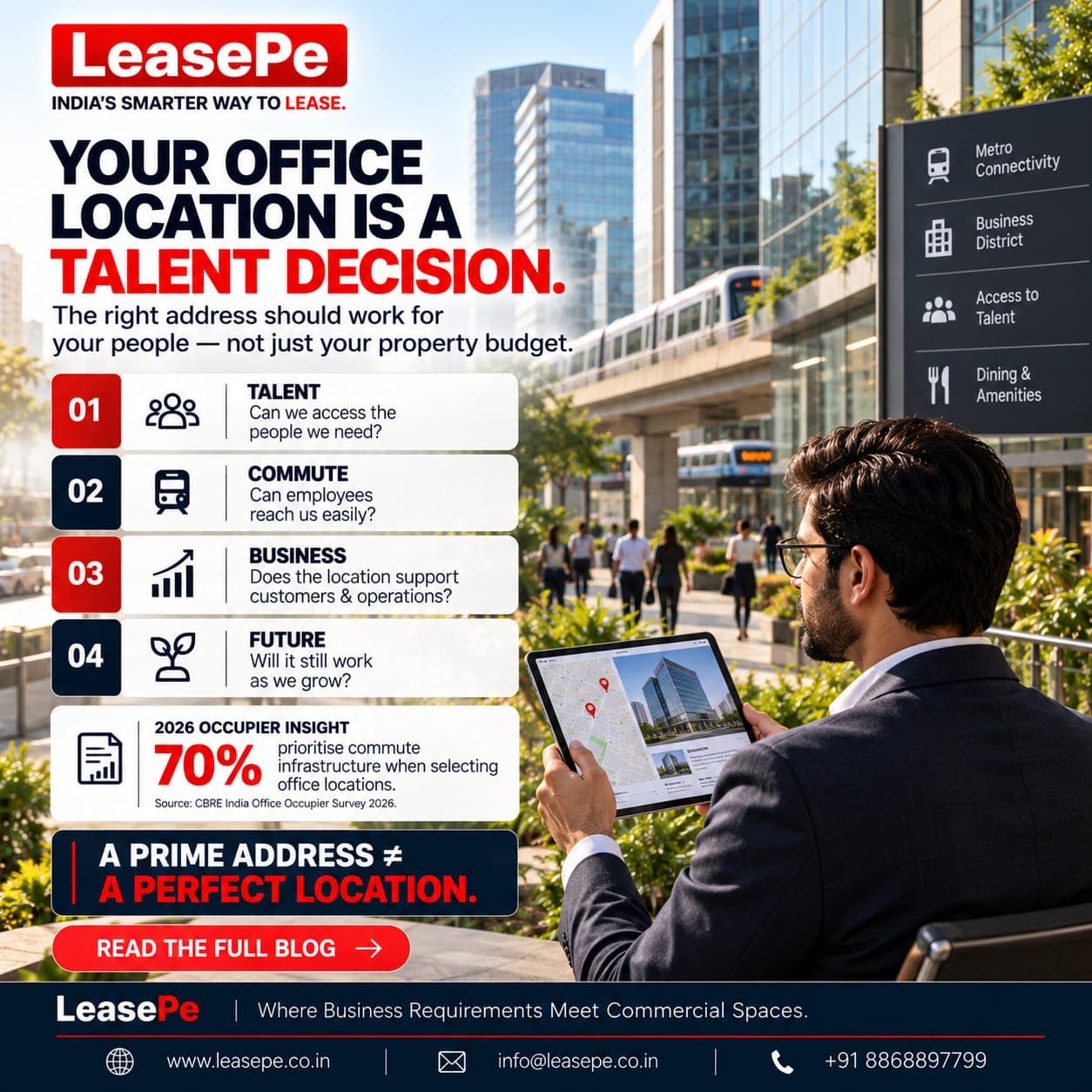
Office Location Strategy: Why Your Commercial Location Is a Talent Decision | LeasePe
Your office location affects more than rent. Learn how commute, talent access, workplace experience and location psychology influence commercial leasing decisions in India.