Commercial Property Leasing: Why Time-to-Open Matters More Than Rent | LeasePe
real estate
Commercial Property Leasing: Why Time-to-Open Matters More Than Rent | LeasePe
A commercial property can look affordable but still cost a business time and momentum. Learn why time-to-open, readiness and speed matter when leasing commercial space in India.
8 October 2026Admin8 min read
The Hidden Cost of a Slow Commercial Lease: Why Time-to-Open Matters More Than Rent
A business finds a property.
The rent looks reasonable.
The location works.
The space looks right.
So everyone thinks:
“We found the property.”
But they haven't.
They have only found a possibility.
Because the real question is:
How quickly can this space become a functioning part of the business?
That question is often overlooked in commercial property leasing.
A business doesn't lease a shop simply to possess the keys.
It leases the space to open, operate, serve customers, employ people, generate revenue and grow.
Every unnecessary week between property selection and business opening can carry a cost.
And sometimes that cost is larger than a small difference in monthly rent.
1. RENT IS VISIBLE. TIME ISN'T.
When businesses compare commercial properties, rent is easy to see.
₹2 lakh/month.
₹2.25 lakh/month.
₹2.5 lakh/month.
Time is harder to put on the comparison sheet.
But imagine two properties.
Property A
Lower rent.
But requires:
additional fit-out
utility work
approvals
repairs
infrastructure changes
longer possession timeline
Property B
Slightly higher rent.
But:
possession is faster
infrastructure is more suitable
fit-out requirements are lower
utilities are ready
the business can start sooner
Which property is actually cheaper?
The answer depends on the business objective, not simply the rent.
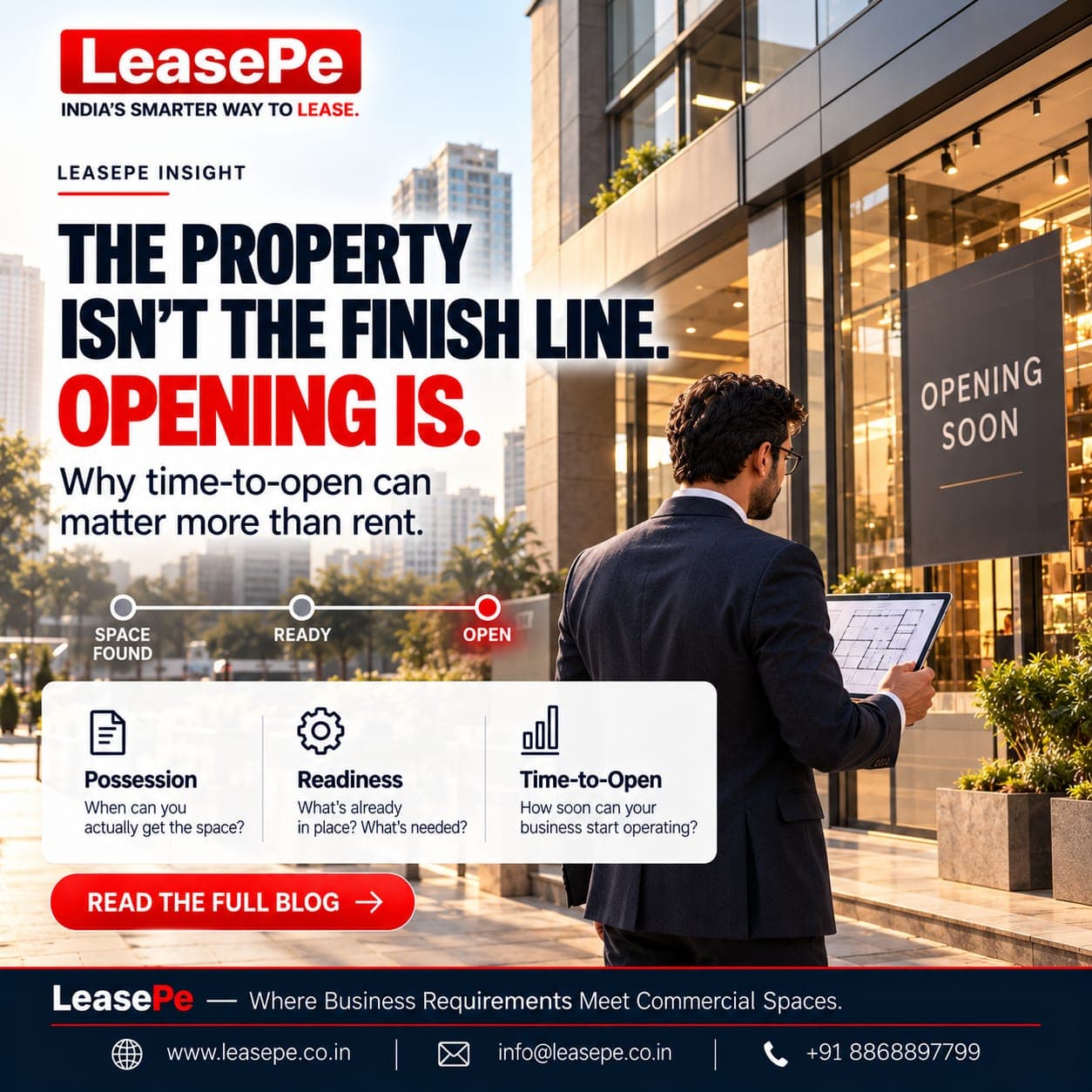
This is why commercial property should increasingly be evaluated through the lens of time-to-open.
2. THE BUSINESS ISN'T BUYING SPACE. IT IS BUYING TIME TO OPERATE.
Think about a retail brand.
The brand has already invested in:
employees
inventory
marketing
technology
supply chain
launch planning
Now imagine the store is delayed by six weeks because the property isn't operationally ready.
The lease may not have become dramatically more expensive.
But the business has lost something else:
momentum.
For a growing business, momentum matters.
A delayed opening can affect:
Revenue timing
Hiring plans
Marketing campaigns
Customer acquisition
Inventory movement
Expansion schedules
The physical property is therefore connected to a much larger business system.
3. WHY BUSINESSES ARE BECOMING MORE SENSITIVE TO SPEED
This isn't only a theoretical shift.
The Indian commercial real-estate market is seeing greater adoption of flexible workspace models partly because businesses value operational agility, scalability and speed to market.
Cushman & Wakefield reported that flexible workspace operators leased 191,306 seats across India's top eight cities in H1 2026, up 68.4% YoY. The firm specifically identified operational agility, scalability and speed-to-market as factors behind continued occupier preference for flexible workspace solutions.
Cushman & Wakefield
Colliers similarly identifies rising flex adoption as one of the structural drivers of India's 2026 office market, with flex leasing projected to represent 20–25% of annual leasing activity.
Colliers +1
The important insight isn't:
“Everyone should choose flex.”
It is:
Businesses increasingly value the ability to adapt quickly.
And that changes how commercial space should be evaluated.
4. THE PSYCHOLOGY OF DELAY
There is also a human reason why speed matters.
When a business commits to a property, uncertainty doesn't disappear.
It often increases.
People start asking:
What if the work takes longer?
What if approval takes another month?
What if the contractor delays?
What if the actual usable space isn't what we expected?
What if we cannot open on the date we planned?
Every unresolved question creates decision anxiety.
And when uncertainty accumulates, people become more cautious.
This is why a commercially attractive property can lose momentum during the transition from:
We like this property.
to
Let's sign.
The problem isn't always price.
Sometimes it is confidence in execution.
5. THE REAL LEASING TIMELINE
A commercial lease shouldn't be viewed as:
Search → Lease
The actual journey is closer to:
SEARCH
Finding potential properties.
↓
SHORTLIST
Comparing business fit.
↓
SITE VISIT
Validating the physical reality.
↓
COMMERCIAL DISCUSSION
Understanding rent and terms.
↓
DUE DILIGENCE
Reviewing relevant information and documentation.
↓
AGREEMENT
Finalizing the commercial arrangement.
↓
POSSESSION
Getting control of the space.
↓
FIT-OUT / SET-UP
Making the property operational.
↓
OPENING
Starting the business.
The lease is only one milestone.
The real outcome is operational readiness.
6. THE “READY” PROPERTY HAS A DIFFERENT VALUE
Imagine two 5,000 sq. ft. commercial spaces.
Both have similar rent.
Both are in good locations.
But:
Property A:
Requires significant modification before operations.
Property B:
Already has infrastructure closer to the business requirement.
The second property may create more value even without offering a lower rent.
Why?
Because it reduces the distance between:
We have the property.
and
We are open for business.
That distance is commercially important.
7. TIME-TO-OPEN SHOULD BECOME A LEASING METRIC
Businesses traditionally compare:
rent
area
location
deposit
escalation
parking
Add one more question:
How long will it take us to become operational here?
A simple evaluation framework could look like this:
Factor
Question
Possession
When can the business actually access the space?
Readiness
What is already available?
Fit-out
What needs to be changed?
Utilities
Are required services available?
Approvals
What additional permissions may be needed?
Setup
How much work is required before opening?
Launch
What is the realistic opening timeline?
This doesn't mean every property needs to be “ready-to-use.”
Different businesses have different requirements.
A manufacturing facility, retail showroom, corporate office and warehouse will naturally have different setup timelines.
The point is simply:
Time should be evaluated alongside space.
8. THE HIDDEN COST OF WAITING
Consider a simplified example.
A business expects to generate ₹10 lakh/month after opening.
Property A allows opening in 30 days.
Property B requires another 90 days.
The monthly rent difference between them is ₹50,000.
At first glance:
Property B looks cheaper.
But the business is potentially waiting two additional months to become operational.
That does not automatically mean Property A is the better decision—the actual revenue, costs, fit-out, demand and business assumptions must be validated.
But it demonstrates an important principle:
The cheapest lease is not necessarily the lowest-cost business decision.
Time changes the economics.
9. WHY THIS MATTERS FOR PROPERTY OWNERS
This isn't only a lesson for businesses.
Property owners can also improve their leasing proposition by understanding what makes a space easier to evaluate and occupy.
The goal isn't to promise that a property is suitable for every business.
It is to make the property's actual readiness easier to understand.
That reduces uncertainty.
And reduced uncertainty can make a serious business conversation easier.
10. THE PRODUCT LESSON FOR COMMERCIAL REAL ESTATE
This is where commercial-property platforms can think differently.
A traditional property marketplace asks:
Which properties are available?
A better product asks:
Which properties can realistically help this business achieve its objective?
That means matching shouldn't stop at:
Location + Area + Budget
It can progressively consider:
Business requirement
↓
Property fit
↓
Operational readiness
↓
Timeline
↓
Site visit
↓
Decision confidence
This is a product-design problem as much as a real-estate problem.
The platform that reduces uncertainty and unnecessary effort can create more value than one that simply displays more inventory.
11. WHAT LEASEPE CAN MEAN BY “BETTER MATCHING”
LeasePe's current model already focuses on connecting commercial property owners with business requirements, reviewing listings, matching relevant opportunities and coordinating site visits and owner connections.
LeasePe +1
The next layer of thinking is:
A good match isn't only a property that fits the requirement.
It is a property that fits the:
Requirement + Business Model + Timeline + Operational Reality
That is a more human way to think about commercial leasing.
Because behind every requirement is a business trying to do something.
Open a store.
Move a team.
Expand a warehouse.
Launch a new branch.
Enter a market.
Scale operations.
12. THE HUMAN SIDE OF COMMERCIAL SPACE
This is easy to forget when looking at property listings.
A commercial space isn't just:
5,000 sq. ft.
It might represent:
50 employees.
500 customers.
A new market.
A new branch.
A founder's expansion plan.
A company's next stage of growth.
That's why the right commercial property can have an impact far beyond its walls.
And that's also why the leasing journey needs to respect the business behind the requirement.
A BETTER WAY TO THINK ABOUT COMMERCIAL LEASING
Instead of asking:
Which property has the lowest rent?
Ask:
Which property gets our business closer to operating successfully?
Instead of:
How big is the space?
Ask:
How effectively can we use it?
Instead of:
When can we sign?
Ask:
When can we realistically open?
Instead of:
Is the property available?
Ask:
Is the property ready for what our business is trying to achieve?
THE LEASEPE PERSPECTIVE
Commercial leasing is often presented as a property transaction.
But businesses experience it differently.
For them, it is a growth decision.
The property affects:
where they operate,
how quickly they can launch,
how their people work,
how customers experience them,
and how easily they can grow.
That is why smarter commercial leasing should look beyond rent and square footage.
The right space isn't simply the space you can lease.
It is the space that helps your business move forward.
Final Takeaway
The next time you compare two commercial properties, don't stop at:
Rent.
Area.
Location.
Add one more question:
How quickly can this space become part of our business?
Because in commercial real estate, time is not just a scheduling issue.
It can be a business advantage.
LeasePe
Where Business Requirements Meet Commercial Spaces.
For businesses looking for commercial space, LeasePe currently supports requirement submission, property discovery, shortlisting and owner coordination. For owners, it supports property registration, review, matching and site-visit coordination.
commercial property leasing
commercial property leasing
Secondary Keywords
commercial property for lease
commercial space for rent
commercial leasing in India
commercial property search
commercial real estate India
office space leasing
retail space leasing
commercial property costs
business expansion
commercial property for business
/blog/commercial-property-time-to-opencommercial property leasing Secondary Keywords commercial property for lease commercial space for rent commercial leasing in India commercial property search commercial real estate India office space leasing retail space leasing commercial property costs business expansion commercial property for business
Discover how commercial property influences customer trust, employee experience, brand perception and business performance—and what businesses should evaluate beyond rent and area.