Commercial Leasing in India: Why Property-Business Matching Matters | LeasePe
real estate
Commercial Leasing in India: Why Property-Business Matching Matters | LeasePe
Discover why successful commercial leasing depends on matching the right property with the right business requirement—not simply listing available space.
/blog/commercial-leasing-property-business-matching
28 September 2026Admin7 min read
Commercial Leasing Is a Matching Problem, Not a Listing Problem
A commercial property can be available.
A business can be actively looking for space.
And yet, the two may never connect.
That is one of the fundamental challenges in commercial leasing.
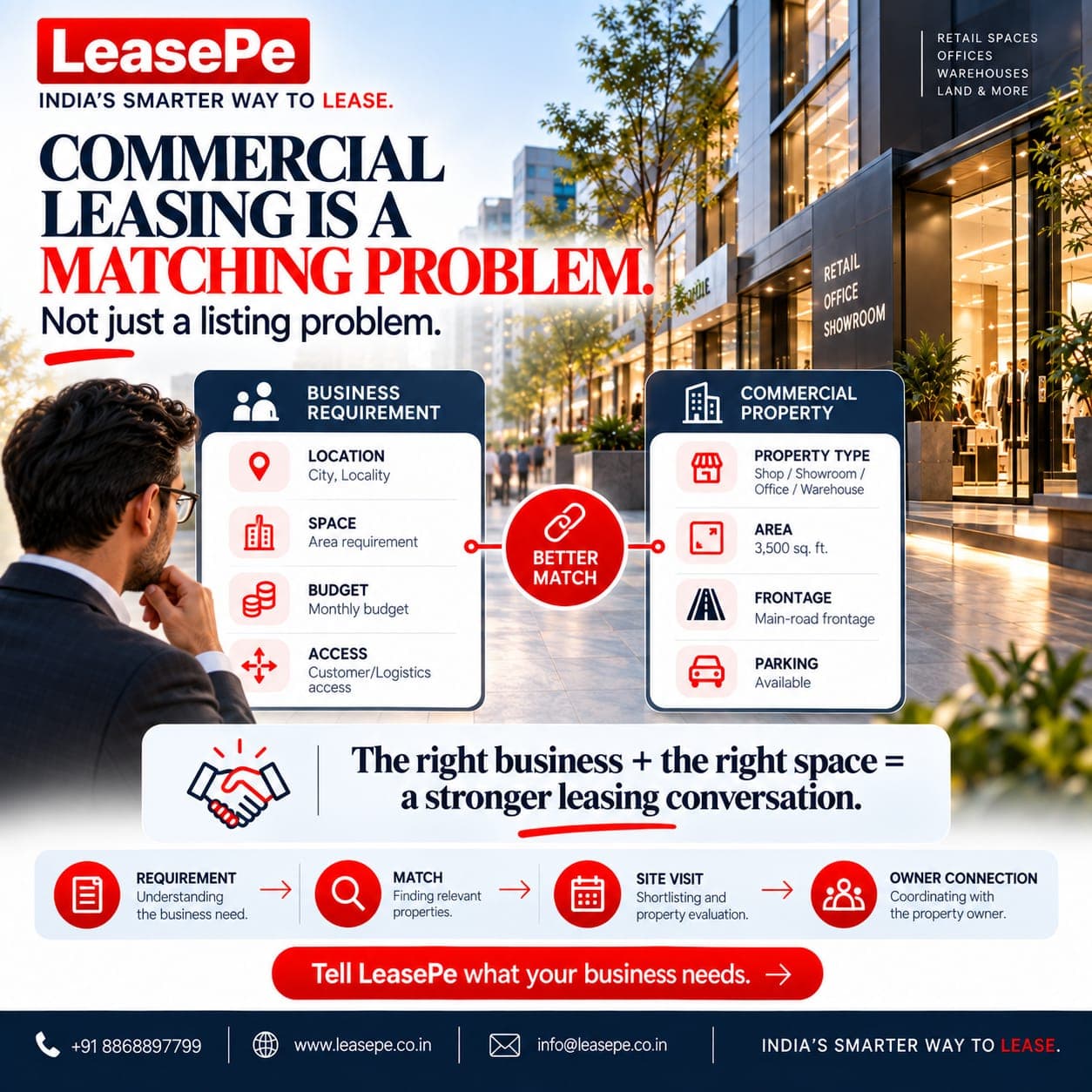
A property owner may have a 3,500 sq. ft. ground-floor commercial space, while a growing business may be searching for a similar-sized property.
But if the location, budget, frontage, access, property type or operational requirements don't align, the property isn't necessarily the right opportunity for that business.
This is why commercial leasing should be viewed as more than a listing exercise.
It is a matching problem.
1. A Property Listing Is Only One Side of the Equation
Traditional property marketing often starts with:
“Property available for lease.”
But a business doesn't search for availability alone.
It searches for a combination of requirements:
Location + Property Type + Area + Budget + Access + Business Fit
For example:
Property
Mumbai
Ground floor
3,500 sq. ft.
Main-road frontage
Parking available
Business Requirement
Delhi
Retail showroom
2,500–4,000 sq. ft.
High visibility
Customer parking
Defined budget
Now there is something more meaningful than two independent listings.
There is a potential match.
LeasePe's current platform is explicitly structured around this owner-and-business connection: owners register properties, businesses submit requirements or search properties, LeasePe reviews and matches relevant opportunities, and the team supports site-visit and owner coordination.
LeasePe
2. Businesses Don't Really Buy “Space”
They use space to achieve a business objective.
A retailer may need a property that helps customers see, access and enter the store.
An office may need:
Employee accessibility
Efficient floor plates
Connectivity
Amenities
Scalability
A warehouse may prioritize:
Loading
Road access
Storage configuration
Logistics efficiency
A factory may require:
Appropriate infrastructure
Power
Operational access
Industrial suitability
The property therefore needs to be evaluated in the context of what the business is trying to accomplish.
This business-first approach is also reflected in how major occupier advisors structure their services.
JLL describes tenant representation around finding space that matches operational needs and location strategy, while Colliers emphasizes aligning real estate strategy with business goals, functionality, flexibility and cost.
JLL +1
3. The “Right Property” Is Different for Every Business
There is no universal definition of a perfect commercial property.
Consider three businesses:
Business
What may matter most
Logistics business
Road access, loading, storage, operational efficiency
The same property could be:
Excellent for one business.
Unsuitable for another.
That is why simply increasing the number of property listings isn't necessarily the complete answer.
The information needs to become relevant to the requirement.
4. Better Information Creates Better Matching
Imagine two listings.
Listing A
Commercial Space Available
3,500 sq. ft.
Call for details.
Listing B
3,500 sq. ft. Ground-Floor Commercial Space
Main-road frontage
Customer parking
Commercial power
Suitable for retail/showroom use
Detailed property information available
The second listing gives a business considerably more information to evaluate.
LeasePe's current property flow similarly focuses on structured information such as property type, location, area, rent and verification status, while its business requirement flow captures location, property type, required area and monthly budget.
LeasePe
That structure matters because matching requires comparable information on both sides.
5. The Business Requirement Is Equally Important
Property platforms often focus heavily on inventory.
But the other side of the marketplace is just as important:
What does the business actually need?
A useful requirement can include:
📍 Preferred location
🏢 Property type
📐 Required area
💰 Budget
🚗 Parking requirement
👀 Visibility/frontage
⚡ Utility requirements
🚚 Loading/access needs
📅 Availability timeline
The more clearly the requirement is defined, the easier it becomes to evaluate whether a property deserves consideration.
LeasePe's current website allows businesses to submit requirements and states that the team can shortlist suitable commercial spaces and connect businesses with property owners.
LeasePe
6. Matching Is More Than Location
Location is important.
But location alone doesn't create a commercial-property match.
A useful matching framework can be thought of as:
LOCATION
Is the market and micro-location appropriate?
SPACE
Does the area and configuration work?
ECONOMICS
Does the commercial structure fit the budget?
ACCESS
Can customers, employees or logistics reach it?
OPERATIONS
Can the business actually operate effectively from the property?
TIMING
Is the property available when the business needs it?
DOCUMENTATION
Is the information required for evaluation available?
This is consistent with the broader direction of professional occupier services. CBRE, for example, describes site selection as evaluating location through factors such as labour availability, logistics and incentives, while JLL incorporates site metrics, market dynamics and business considerations into location strategy.
CBRE India +1
7. From Search to Shortlist
The real objective of a commercial leasing platform shouldn't necessarily be:
“Show me more properties.”
It should be:
“Help me identify properties worth considering.”
That creates a more useful journey:
BUSINESS REQUIREMENT
↓
PROPERTY DISCOVERY
↓
MATCHING
↓
SHORTLIST
↓
SITE VISIT
↓
OWNER CONNECTION
↓
COMMERCIAL DISCUSSION
↓
LEASE
LeasePe's current website describes a similar assisted flow, moving from property registration and review through requirement matching, site-visit coordination, owner connection and lease finalization.
LeasePe
8. Owners Need Matching Too
This isn't only a tenant problem.
Property owners also need the right business requirement.
A property owner doesn't simply want:
“More enquiries.”
A more useful outcome is:
“Relevant enquiries.”
For example, a warehouse owner may benefit more from a genuine logistics requirement than from dozens of unrelated retail enquiries.
This makes the quality of the requirement important for both sides.
For businesses:
Better requirements → Better property discovery
For owners:
Better property information → Better business discovery
For the platform:
Better information on both sides → Better potential matching
9. Why This Changes How Commercial Property Should Be Marketed
If commercial leasing is a matching problem, then property marketing should change.
Instead of focusing only on:
“PROPERTY AVAILABLE”
the listing should answer:
WHAT IS THIS PROPERTY?
Property type, area and configuration.
WHERE IS IT?
City, locality, road and surrounding market.
WHAT DOES IT OFFER?
Frontage, parking, utilities and access.
WHO COULD IT SUIT?
Retail, office, logistics, manufacturing or another relevant use.
WHAT ARE THE COMMERCIAL TERMS?
Rent and applicable leasing information.
This doesn't mean promising that a specific brand will take the property.
It means presenting the property clearly enough for relevant businesses to evaluate it.
10. Where LeasePe Fits
LeasePe currently positions itself as a commercial leasing partner for owners and brands.
The platform supports commercial categories including:
Offices
Shops
Showrooms
Warehouses
Godowns
Factories
Industrial spaces
Commercial land
Verified Commercial Properties
Genuine Brand Requirements
Local Market Expertise
End-to-End Leasing Support
Direct Owner Coordination
Faster Property Matching.
LeasePe
Importantly, the current website does not promise that every listed property will get a tenant; it says LeasePe supports discovery, matching, requirement review and owner-brand coordination.
LeasePe
That distinction is important for credible commercial-real-estate marketing.
The New Way to Think About Commercial Leasing
The difference is subtle—but strategically important.
A commercial property platform isn't only a catalogue of available spaces.
At its most useful, it becomes a connection layer between business requirements and physical commercial space.
For Property Owners
Don't just ask:
“How do I advertise my property?”
Ask:
“Have I given a business enough information to understand why this property could fit?”
Clear property information can make the space easier to evaluate.
For Businesses
Don't just say:
“I need a commercial property.”
Define:
Where + What type + How much space + Budget + Operational requirements
A clearer requirement can make the search more focused.
Final Thought
Commercial leasing isn't simply about finding an empty property.
And it isn't simply about finding a tenant.
It is about bringing together:
The right business requirement
with the right commercial space
at the right point in the leasing journey.
That's where better information, structured requirements and assisted coordination can make commercial leasing more useful.
LeasePe — Where Business Requirements Meet Commercial Spaces.
For property owners: Register your commercial property.
For businesses: Tell LeasePe what space you need.
commercial leasing India, commercial property for lease, commercial space for business, property-business matching, commercial real estate India, commercial property platform, commercial leasing platform
commercial property matching
Explore LeasePe
commercial leasing India, commercial property for lease, commercial space for business, property-business matching, commercial real estate India, commercial property platform, commercial leasing platform
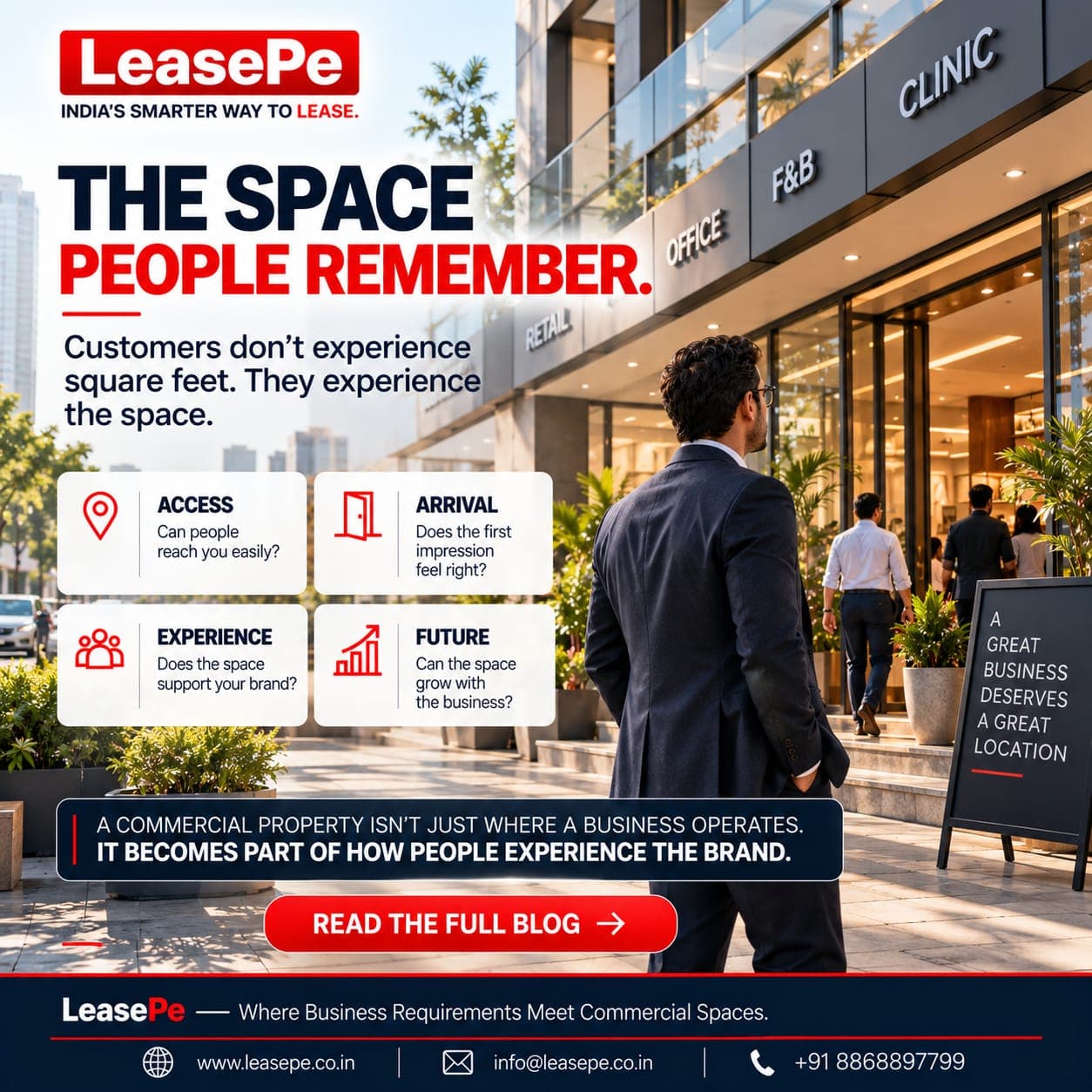
Discover how commercial property influences customer trust, employee experience, brand perception and business performance—and what businesses should evaluate beyond rent and area.