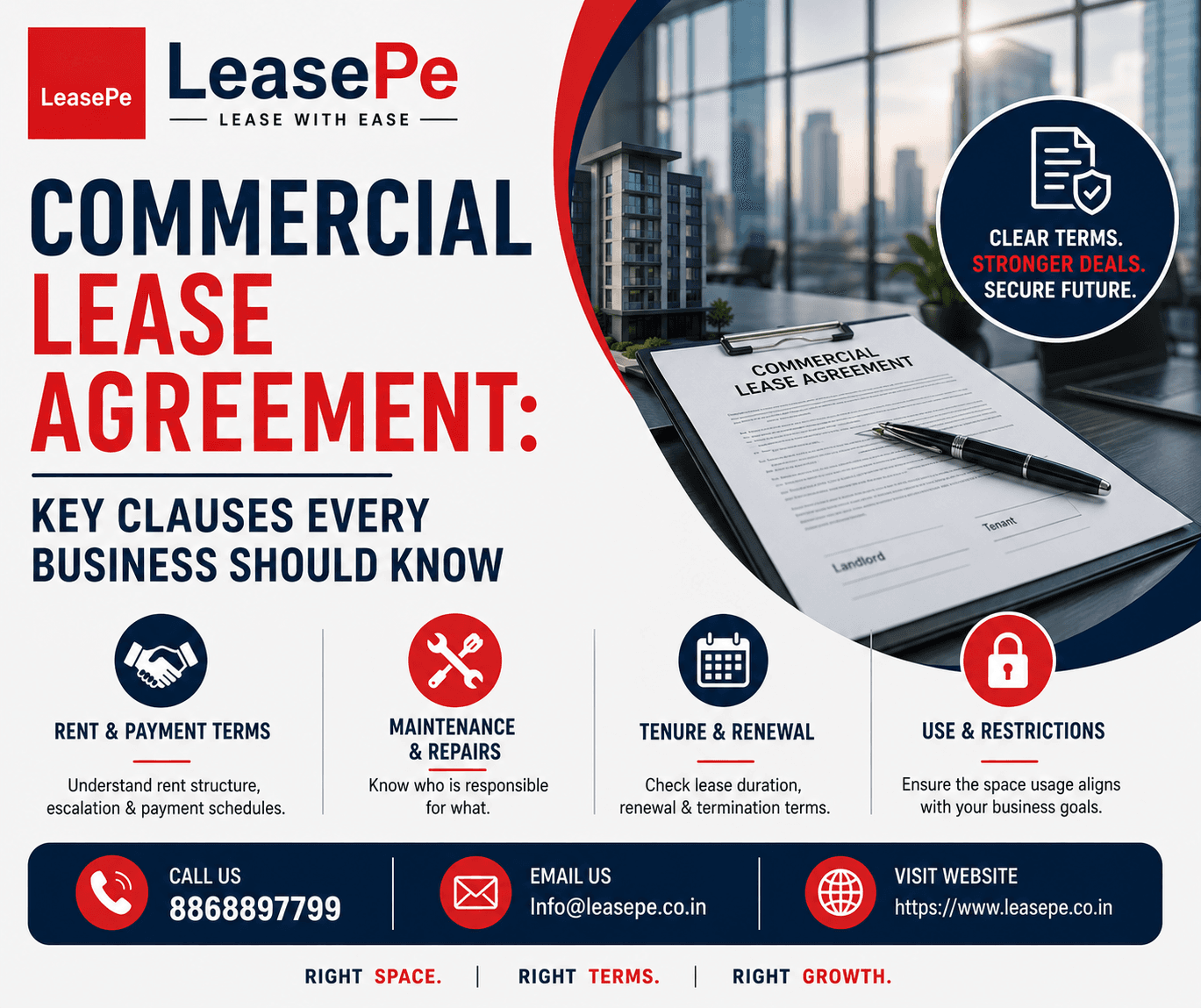
Commercial Lease Agreement: Key Clauses Every Business Should Know
Navigating a commercial lease agreement? Learn the critical clauses—lock-in, CAM, restoration, and escalation—to protect your business with LeasePe.
Commercial Lease Agreement: Key Clauses Every Business Should Know
Signing a commercial lease agreement is a major financial milestone for any scaling company. Whether you are locking down a warm shell office space for a tech team or a high-street showroom for a retail brand, the lease deed you sign will dictate your fixed operating costs and legal liabilities for years to come.
Unlike residential leases, which are highly protected by consumer-friendly local rent control laws, commercial leases operate under the principle of free-market contract law. This means everything is negotiable—and any clause you overlook can be weaponized against your business later.
To safeguard your company's financial runway and operational agility, your legal and real estate teams must master the critical components of institutional contracts. Navigating these complex financial variables is exactly why scaling enterprises rely on platforms like LeasePe to streamline discovery and contract compliance.
Here are the essential, non-negotiable clauses every business leader must evaluate before executing a commercial lease.
THE FOUR WALLS OF A COMMERCIAL LEASE ┌───────────────────────────────┬───────────────────────────────┐ │ 1. THE LOCK-IN CLAUSE │ 2. RENT ESCALATION MAP │ ├───────────────────────────────┼───────────────────────────────┤ │ Ensures operational stability │ Defines future cost increases │ │ but carries high exit risk. │ — must avoid annual traps. │ ├───────────────────────────────┼───────────────────────────────┤ │ 3. CAM BREAKDOWNS │ 4. RESTORATION LIABILITY │ ├───────────────────────────────┼───────────────────────────────┤ │ Variable maintenance risks; │ Dictates back-to-base exit │ │ requires operational caps. │ costs when moving out. │ └───────────────────────────────┴───────────────────────────────┘
1. The Lock-In Period vs. Lease Term A common point of confusion for growing businesses is the difference between the overall lease duration and the mandatory lock-in period.
The Lease Term: The total lifespan of the agreement (typically 3, 5, or 9 years for corporate setups).
The Lock-In Period: The initial window during which neither the landlord nor the tenant can terminate the agreement. If your business outgrows the space during a 36-month lock-in and needs to vacate, you are legally obligated to pay the remaining rent for the balance of that lock-in window.
The Strategic Fix: Ensure your lock-in period matches your near-term growth predictability. If you are a volatile startup, negotiate a shorter lock-in (e.g., 12 to 18 months) even if the total lease term spans 5 years.
Keep reading
Related insights

real estate
Commercial Property Climate Resilience: What Businesses Should Know | LeasePe
Discover how heat, flooding, power reliability and building resilience can affect commercial property leasing in India. Learn what businesses should evaluate before choosing a space.
real estate
Office Location Strategy: Why Your Commercial Location Is a Talent Decision | LeasePe
Your office location affects more than rent. Learn how commute, talent access, workplace experience and location psychology influence commercial leasing decisions in India.