Bare Shell vs Warm Shell vs Fully Furnished Lease: The Growth Guide
Scaling your business? Discover the operational differences between Bare Shell, Warm Shell, and Fully Furnished commercial leases to optimize CapEx and agility.
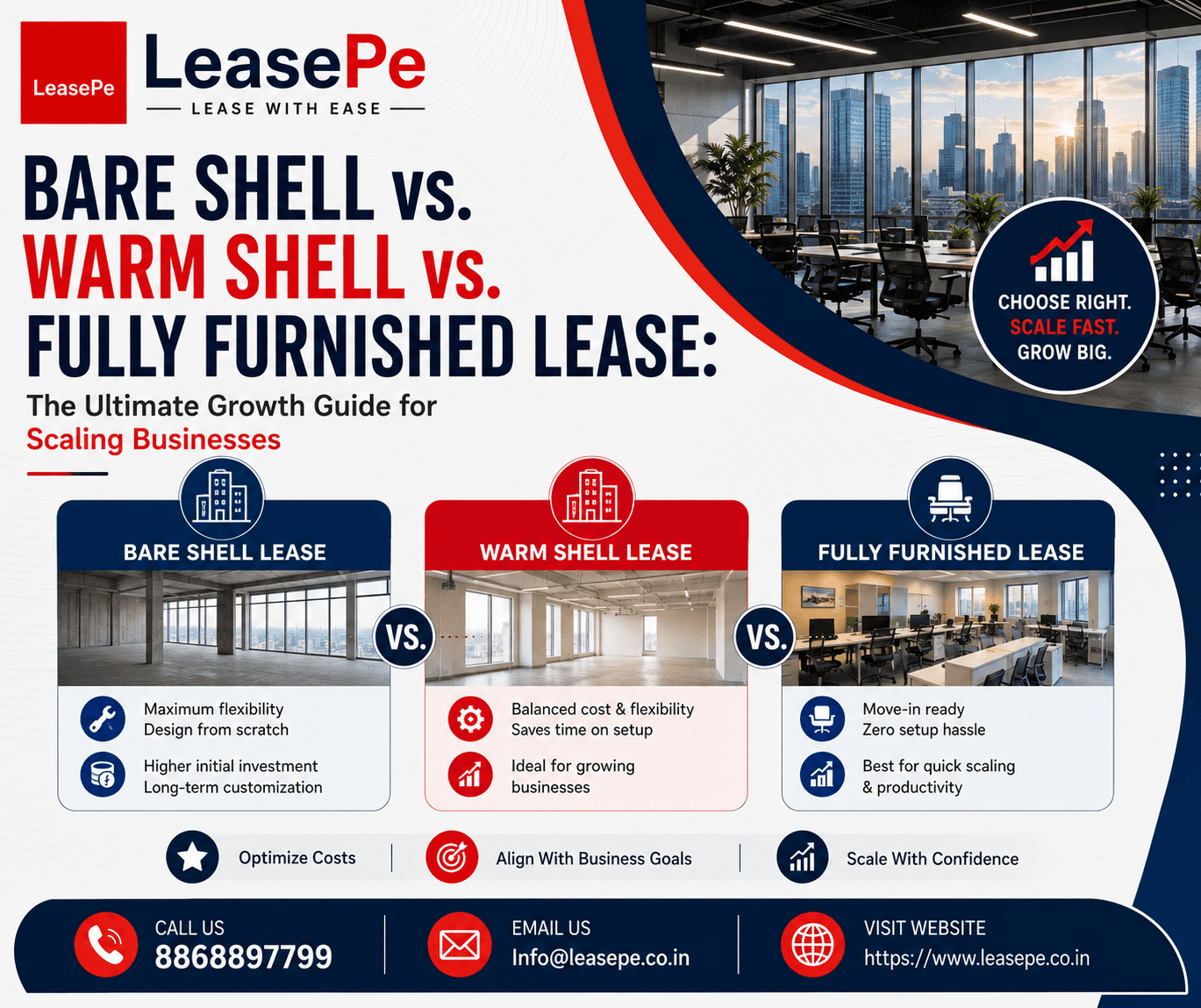
Bare Shell vs. Warm Shell vs. Fully Furnished Lease: The Ultimate Growth Guide for Scaling Businesses
Choosing a new office or retail space is one of the most critical decisions a growth-stage company will make. It isn't just a real estate transaction; it's a major product lifecycle decision for your company. Your physical workspace is the platform that scales your operational velocity, dictates your team's culture, and directly impacts your cash runaway.
When evaluating a commercial property on lease, the choices generally fall into three distinct infrastructure tiers: Bare Shell, Warm Shell, and Fully Furnished.
Making the wrong bet here can severely misallocate your capital—either trapping your growth-stage business in a low-rent space that drains millions in upfront structural fit-outs, or locking you into a premium, rigid layout that you will outgrow in twelve months.
Here is the definitive strategic breakdown from a product-market fit and financial operations perspective.
The Core Product Comparison: Three Structural Tiers To build a reliable expansion roadmap, you must look past the visual aesthetics and evaluate these three space types based on their underlying operational metrics: Upfront Capital Expenditure (CapEx), Monthly Operational Outflow (OpEx), Time-to-Market (Speed of Move-In), and Branding Autonomy.
Core Metric 🔲 Bare Shell (The Blank Canvas) 💡 Warm Shell (The Balanced Core) 🛋️ Fully Furnished (The Turnkey Platform) What's Included? Raw concrete floors, unplastered walls, basic main utility shafts, no internal distributions. Screed flooring, basic false ceiling, operational HVAC ducting, finished restrooms, code-compliant basic lighting. Everything in a warm shell plus cabins, workstations, network cabling, pantry appliances, and office furniture. Upfront Cost (CapEx) Extremely High. You own the entire layout, interior, and utility execution. Moderate. You only finance interior partitioning, customized collaborative zones, and branding. Negligible. You pay the standard security deposit and standard IT setup costs. Monthly Rent (OpEx) Lowest. Landlords offer deep discounts for unconditioned spaces. Moderate. The benchmark rate for standard Grade A properties. Highest. The landlord charges a heavy premium to amortize their interior furniture asset. Deployment Window Slow. Takes 3 to 5 months for architectural validation, approvals, and physical build. Agile. Takes 3 to 6 weeks for light personalization and desk layout setups. Instant. Turnkey deployment can occur within 24 to 48 hours. Branding Autonomy 100% Control. Zero architectural constraints. High Control. You dictate the workflow layout around a pre-installed utilities core. Low Control. Bound entirely by the landlord’s pre-existing spatial design choices. Deep-Diving Into the Three Tiers 1. Bare Shell (Cold Shell)
Keep reading
Related insights
real estate
Commercial Property Climate Resilience: What Businesses Should Know | LeasePe
Discover how heat, flooding, power reliability and building resilience can affect commercial property leasing in India. Learn what businesses should evaluate before choosing a space.
real estate
Office Location Strategy: Why Your Commercial Location Is a Talent Decision | LeasePe
Your office location affects more than rent. Learn how commute, talent access, workplace experience and location psychology influence commercial leasing decisions in India.